
%201.svg)


PAT testing is one of those terms nearly every UK business owner, landlord and facilities manager has come across — but few can explain with any confidence. If you've been told your workplace, rental property or premises needs it, and you're not entirely sure what "it" is, this guide is for you.
Below, we'll cover what PAT testing actually is, what it involves, who legally needs it, how often it has to be done and who's qualified to carry it out. By the end, you'll have a clear picture of where you stand — and what (if anything) you need to do next.
What is PAT testing, in plain English?
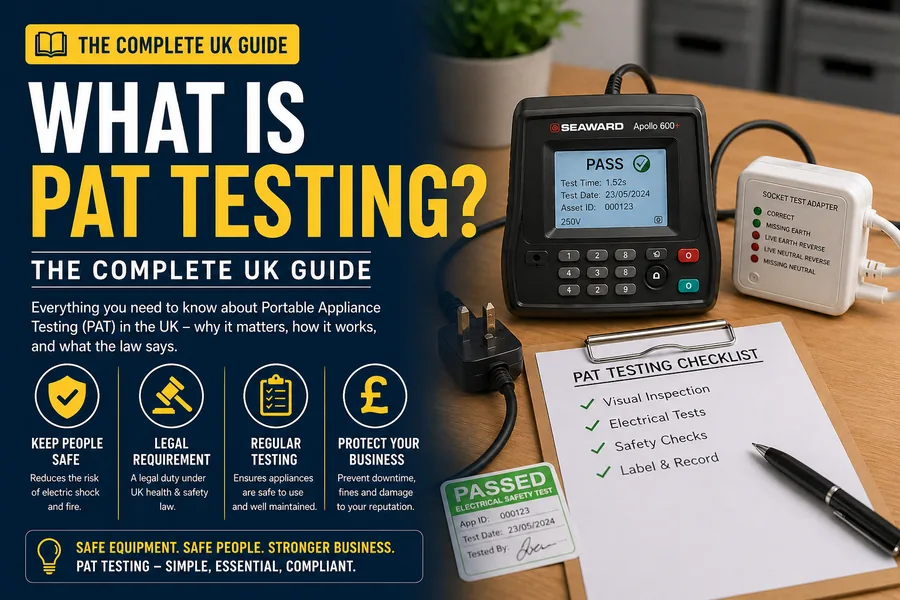
PAT testing stands for Portable Appliance Testing. It's a process of checking that electrical appliances are safe to use, combining a visual inspection with a series of electrical tests.
The word "portable" is slightly misleading. In PAT testing terms, a portable appliance is any piece of electrical equipment that plugs into a standard socket and can reasonably be moved — so a kettle, a laptop charger, a floor lamp, a microwave, even a fridge-freezer. It doesn't have to be lightweight. If it has a plug on the end and it's not permanently wired into the building's fixed electrical system, it generally falls under the PAT testing umbrella.
The purpose is straightforward: electrical appliances develop faults over time. Cables fray, plugs crack, earth connections work loose, insulation breaks down. A PAT test catches those faults before they cause a shock, a fire or a workplace injury — and gives the person responsible for the premises documented proof that the appliance was safe on the date it was tested.
What does PAT testing actually involve?
A common assumption is that PAT testing is just about plugging a device into a testing machine and waiting for a green light. In reality, the electrical tests are only one half of the process — and often not the half that catches the most faults.
Visual inspection
Every PAT test begins with a formal visual inspection. The tester checks the appliance, the plug, the cable and any accessories for signs of damage or wear. That includes:
- Cracks, scorch marks or melting on the plug or casing
- Frayed, cut or damaged cables
- Bent or bare pins on the plug
- Signs of overheating (discolouration around the plug or socket)
- Incorrect fuse ratings
- Loose screws inside the plug (where rewireable plugs are used)
- Appropriate use — for example, a desktop PC in a damp workshop would be flagged as unsuitable, even if the appliance itself tests perfectly
Around 90% of PAT test failures are spotted at this visual stage, not by the testing machine. It's by far the most important part of the process.
Electrical testing
Where the appliance passes visual inspection, a PAT tester (the machine) carries out a series of electrical tests. The specific tests depend on the class of appliance — which we'll explain in a moment — but they typically include:
- Earth continuity test. On Class 1 appliances, a low-current test confirms that the earth pin on the plug is properly connected to the metal casing of the appliance. If the earth connection is broken, a fault inside the appliance could make the metal casing live, with potentially fatal consequences.
- Insulation resistance test. A higher voltage is applied between the live parts and the earth (or casing) to check that the insulation hasn't broken down. Weak insulation can allow current to leak where it shouldn't.
- Polarity check. On appliances with a detachable lead, the tester confirms that live and neutral are wired the right way round.
- Earth leakage test. Some testers also measure how much current is leaking to earth under normal operating conditions.
- Functional check. The appliance is briefly powered up to confirm it actually works.
Each test has a pass/fail threshold set out in IET guidance. The appliance either passes all tests or it doesn't — there's no middle ground.
Labelling and record-keeping
Once tested, the appliance gets a pass (or fail) label showing the date of the test, the next test date (where appropriate) and the tester's identifier. The results are recorded — either on paper, in a spreadsheet or (most commonly today) in PAT testing software. We cover documentation in detail in our PAT testing certificate guide and record sheet template post.
The name has officially changed — here's why
Strictly speaking, "PAT testing" isn't the official term any more. In 2020, the Institution of Engineering and Technology (IET) updated its guidance and rebranded the whole process as "In-service Inspection and Testing of Electrical Equipment."
The reasoning was twofold. First, it was never just about "portable" equipment — fixed appliances like hand dryers or wall-mounted heaters have always been included. Second, the word "testing" underplays the visual inspection that does most of the work.
In practice, nearly everyone — including the HSE, trade publications and training providers — still uses "PAT testing." It's the term you'll see on certificates, in tenders and in legal documents. We use it throughout this site for the same reason: it's what people actually search for and what they'll recognise.
Who needs PAT testing?
PAT testing doesn't apply to everyone. Broadly, it applies to anyone with a legal duty of care over other people in relation to electrical equipment. That includes:
- Employers. The Health and Safety at Work Act 1974 and the Electricity at Work Regulations 1989 require employers to keep electrical equipment safe. PAT testing is the standard way most UK employers demonstrate they've done this.
- Landlords. All landlords — including those letting HMOs and holiday lets — have duties under various housing and safety regulations. We cover this in detail in our dedicated PAT testing for landlords guide.
- The self-employed, where their work could affect other people.
- Organisations responsible for public premises, including schools, colleges, hotels, shops and leisure centres.
What about your own home? Homeowners are not required to PAT test their personal appliances. The regulations cover appliances used at work or in rented accommodation, not those used privately by the person who owns them. We explore the exceptions — and when home testing genuinely makes sense — in our domestic PAT testing post.
Whether PAT testing is technically legally required is more nuanced than most people realise. The short version: no single law says "thou shalt PAT test." But several laws require you to keep electrical equipment safe, and PAT testing is the recognised way to do that. Our full answer is in our dedicated guide on whether PAT testing is a legal requirement in the UK.
Who can carry out PAT testing?
This is one of the biggest misconceptions in the industry: you don't need to be a qualified electrician to carry out PAT testing. The law requires a "competent person" — someone with the knowledge, skill and equipment to do the job safely and correctly.
Competency can be demonstrated through experience, but for most businesses, the cleanest route is a short training course. A proper PAT testing training course gives you the theoretical understanding (regulations, classes of appliance, what the tests are doing) and the practical skill to operate a tester and interpret results — typically in one day.
From there, you can either test your own organisation's equipment in-house or set up as an independent PAT tester. We cover the full details in our guide to who can do PAT testing.
How often should PAT testing be done?
The most common misconception about PAT testing is that it's an annual requirement. It isn't. The HSE takes a risk-based approach: the frequency depends on the type of appliance, the environment it's used in and how it's used.
A handheld drill on a construction site needs checking much more often than a desk lamp in a quiet office. Rental property appliances need a different approach to school IT equipment. We've put together a full breakdown, with a proper UK frequency table, in our post on how often PAT testing should be done.
What appliances need PAT testing?
The short answer is: any mains-powered electrical appliance used in a commercial, rental or workplace setting. The longer answer depends on whether the appliance is Class 1 (reliant on an earth for protection) or Class 2 (double-insulated and no earth required) — a distinction we explain in our Class 1 vs Class 2 guide.
Certain categories have their own quirks — IT equipment, extension leads, fixed appliances and brand-new equipment all have specific considerations. You'll find the complete breakdown in our full list of appliances that need PAT testing.
What equipment is used for PAT testing?
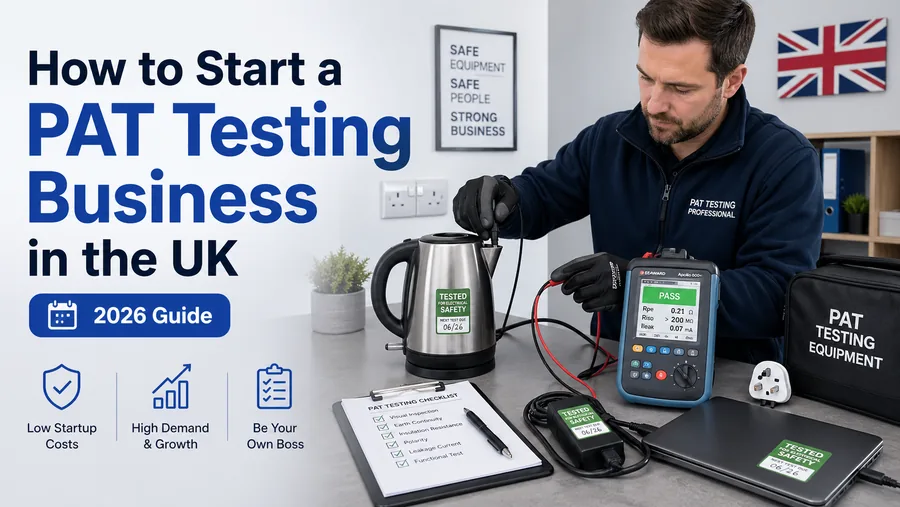
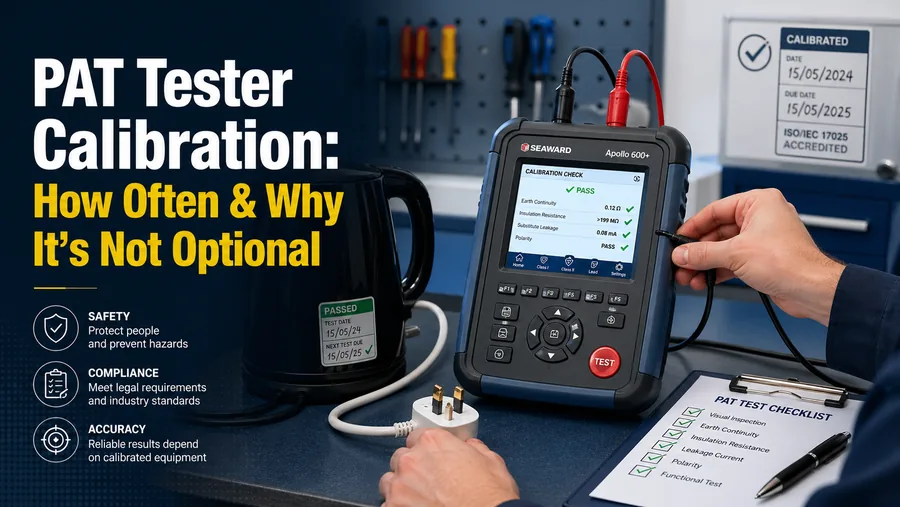
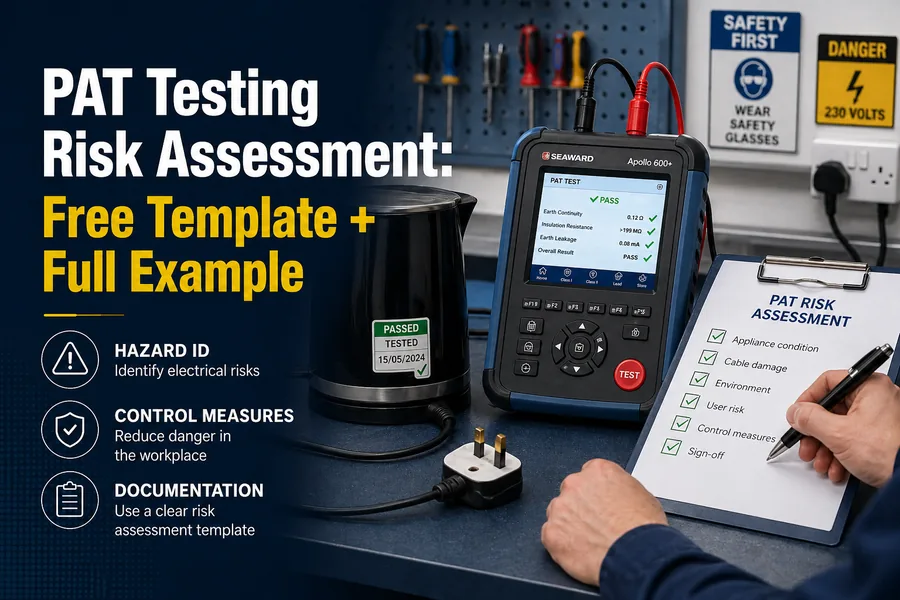
PAT testing requires a dedicated PAT tester — a specialised piece of equipment that carries out the electrical tests automatically and either displays or stores the results. Entry-level pass/fail testers start at around £200; advanced models with downloadable results, barcode scanners and built-in printers run to £2,000 or more.
Alongside the tester itself, you'll need pass/fail labels, a means of recording results (software or spreadsheets) and — for professional testers — a calibration certificate proving your equipment gives accurate readings. Our PAT testing equipment guide walks through what to look for when choosing a tester.
What does PAT testing cost?
Prices vary significantly depending on where you are in the UK, how many items you're testing and whether you're using an in-house tester or an external contractor. As a rough guide, external PAT testing in the UK typically costs £1 to £2 per item, with a minimum call-out fee of £40 to £80. Testing in-house works out far cheaper over the long run once you've trained a staff member and bought a tester — usually paying for itself within one or two rounds of testing. We break down the sums in our PAT testing cost guide.
Common PAT testing misconceptions
A few myths come up so often that they're worth addressing head-on:
"PAT testing is legally required every year." It isn't. Frequency is risk-based, and many appliances in low-risk environments don't need annual testing at all.
"You have to be a qualified electrician to PAT test." You don't. You need to be a competent person, which a one-day course can generally achieve.
"Every single plug needs testing." Not necessarily — some items (like permanently connected fixed appliances) are handled differently, and very low-risk items sometimes only need visual checks.
"PAT testing certificates expire." The certificate itself doesn't expire in any legal sense — it's a record of a test carried out on a specific date. What expires is the validity of that test for your safety purposes, which depends on your testing frequency, not a universal sell-by date.
"New appliances don't need PAT testing." Brand-new equipment generally only needs a visual inspection before first use, not a full electrical test. But "generally" is doing heavy lifting in that sentence — our post on PAT testing new appliances covers the exceptions.
Frequently asked questions
What does PAT stand for?
Portable Appliance Testing. Officially renamed to "In-service Inspection and Testing of Electrical Equipment" in 2020, though the old name is still near-universally used.
Is PAT testing legally required?
There's no single UK law that says it is. But the Electricity at Work Regulations 1989 and the Health and Safety at Work Act 1974 require you to keep electrical equipment safe, and PAT testing is the standard way to do that. See our full guide.
How long does a PAT test take?
For a standard portable appliance, the full test (visual inspection plus electrical tests) takes around one to three minutes. A competent tester can comfortably work through 80–150 items in an average working day.
Can I PAT test my own appliances?
If you're testing your own workplace's equipment, yes — provided you're a competent person. That usually means completing a short accredited PAT testing training course. If you're testing as a paid service for others, you'll also need appropriate insurance.
Does a fridge need PAT testing?
If it's in a workplace, rental property or public building: yes, at whatever frequency is appropriate for its risk level. If it's your own home fridge: no.
Is PAT testing the same as an EICR?
No. A PAT test checks individual appliances; an EICR (Electrical Installation Condition Report) checks the fixed electrical installation of a building — the wiring, consumer unit and circuits. We compare them in detail in our post on PAT testing vs EICR.
Getting started with PAT testing
If you're reading this because someone has told you your business or rental property needs PAT testing, your next step depends on what you want to achieve.
If you want it done once, quickly, and don't anticipate regularly needing it: hiring an external contractor is the simplest route.
If you have more than a handful of appliances, multiple sites or ongoing testing needs, training a staff member pays for itself remarkably quickly. A single-day course, a reliable PAT tester and a record-keeping system is all it takes to bring the whole process in-house. If that's the direction you're heading, take a look at our nationwide PAT testing courses — we run accredited training in locations across the UK, with everything you need to be testing competently the following day.
Either way, you now know what PAT testing is, why it exists and what your responsibilities look like. The rest is just execution.