
%201.svg)


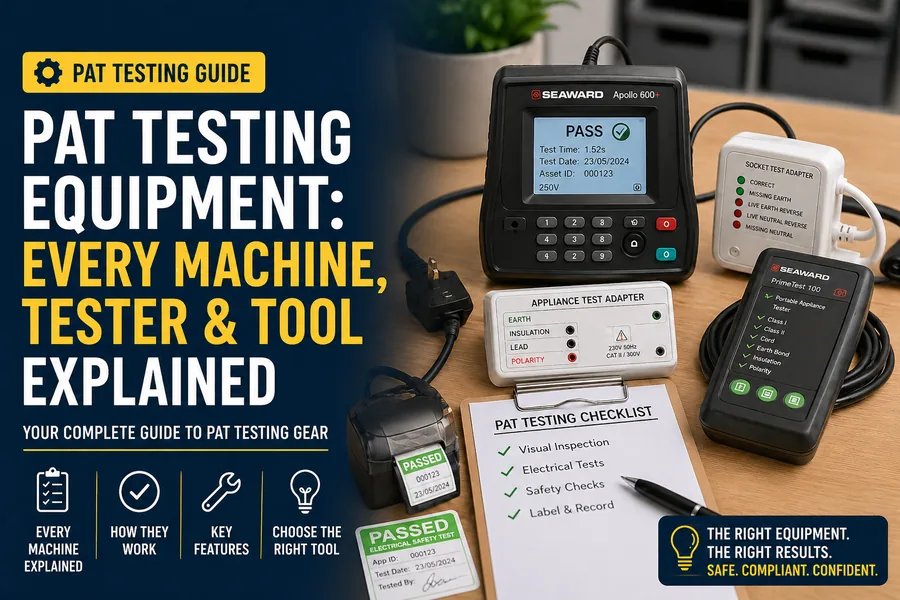
If you've started looking at PAT testing equipment and ended up more confused than when you began, you're not alone. The market is crowded with brands, tester types, software packages and accessories — and most product pages assume you already know what you're looking at.
This guide breaks down every piece of equipment involved in PAT testing, what each one actually does, and what you realistically need depending on how you'll be using it.
What equipment do you actually need?
At its simplest, PAT testing requires three things:
- A PAT tester — the machine that carries out the electrical tests
- A way of labelling appliances — usually pass/fail stickers or tags
A way of recording results — paper, spreadsheet or software
Everything else — barcode scanners, printers, calibration kit, test leads, carry cases — is an optional extra. A well-organised tester can do solid work with nothing more than a mid-range tester, a pack of labels and a clipboard. Adding the optional extras makes the job faster and the paperwork cleaner, but they don't change whether the testing itself is valid.
The PAT tester: the core piece of equipment
The PAT tester is the machine that runs the electrical tests on each appliance. It's typically a handheld unit, battery or mains-powered, with a socket for the appliance's plug and a set of probes for external testing.
There are three broad tiers.
Tier 1: Pass/fail testers (£150–£400)
The most basic PAT testers are simple pass/fail devices. You plug the appliance in, press a button, and a light (or the machine's LCD) tells you whether the appliance has passed or failed. There's no way to download results — you record them manually.
Who they suit: small businesses with a limited number of appliances, or landlords testing their own rental properties. The lack of data logging becomes a chore once you're testing more than about 30 items at a time, but for occasional use they're perfectly serviceable.
Tier 2: Downloading testers with basic data management (£400–£1,000)
The next tier adds the ability to store test results in the machine and download them to a computer. They typically display detailed readings (e.g. earth continuity in ohms, insulation resistance in megohms) rather than just pass/fail. You can record an asset number for each item and build up a record of tests over time.
Who they suit: small contractors, landlords with multiple properties, mid-sized businesses testing in-house. This tier represents the sweet spot for most buyers.
Tier 3: Advanced testers with full asset management (£1,000–£2,500+)
At the top end are testers with large displays, built-in printers, barcode scanners, bluetooth connectivity and full asset-management software suites. Some can be operated almost like a small computer — you scan the asset tag, the machine pulls up the previous test history, runs the tests and updates the record automatically.
Who they suit: full-time professional PAT testing businesses or large organisations with thousands of items to track. The productivity gain is real at volume but disproportionate to the cost for small-scale use.
What to look for regardless of tier
Some features matter at every price point:
- Automatic test sequences. The tester should recognise Class 1 vs Class 2 (either via the plug or user selection) and run the correct sequence of tests without prompting. Manual test selection becomes error-prone at speed.
- Extension lead testing capability. Most testers handle extension leads automatically via a dedicated function.
- Earth leakage (substitute or differential). Full leakage testing is increasingly standard and useful for appliances sensitive to the higher insulation test voltage.
- 230V and 110V capability if you're ever likely to work on construction sites (110V centre-tap transformer supplies are standard there).
- Accessible test thresholds. The tester should either display or allow you to set the IET pass/fail thresholds — useful for understanding marginal results rather than treating every pass as equal.
Brands commonly used in the UK
The UK market is dominated by a small handful of manufacturers: Seaward, Megger, Martindale, Kewtech, Metrel and Fluke. Any PAT tester from these brands, bought new and calibrated, will do the job. Brand loyalty is mostly a matter of which user interface the tester prefers — the core test functionality is comparable across them.
Pass/fail labels and asset tags
Once an appliance has been tested, you need to mark it as tested. The industry standard is a small adhesive label showing:
- Whether the appliance passed or failed
- The test date (and often the next test date)
- An identifier for the tester or testing company
There are two main label types:
Generic pass/fail stickers. Pre-printed rolls of green "pass" and red "fail" stickers with blank fields for date and tester. The cheapest option — a few pounds per thousand.
Printed asset labels. For higher-volume testing, you can print labels directly from your tester or PC, including the asset number, test details and sometimes a barcode. This is essential if you're using barcode-scanning workflows, and useful for multi-site operations where an asset number is the primary identifier.
For testing at volume, asset tags are also worth considering — more durable labels that survive environment exposure and remain legible for the full test interval. They're particularly useful for outdoor equipment, kitchen appliances and tools.
Documentation beyond the label — the full record of the test — is covered in our posts on PAT testing certificates and record sheet templates.
PAT testing software
Software sits between your tester and your record-keeping. At minimum, it lets you import test results from the tester and export reports for clients or internal records. At the more advanced end, it becomes a full asset management system — tracking test history, scheduling retest reminders, producing client invoices and managing multiple sites.
Most PAT tester manufacturers sell their own proprietary software, typically bundled free with mid-range testers or as a paid upgrade. Third-party options (such as PATGuard, SimplyPats and others) tend to be more flexible, particularly for testers working across multiple tester brands.
For occasional in-house use, proprietary software is usually fine. For a professional PAT testing business, a proper third-party solution saves hours per week once you're past about 50 tests.
Calibration equipment
Calibration isn't something you do to your tester yourself — it's a process of sending the tester away (or having an engineer come to you) to verify that its readings are accurate to a traceable standard. After calibration, you receive a certificate stating that on a specific date, with specific readings, the machine was performing within tolerance.
Calibration is typically done every 12 months. It's not strictly legally required, but it is:
- Required by most accrediting bodies (if you're certified through an organisation)
- Required by most insurers for professional PAT testers
- Expected in any professional context — an out-of-calibration tester's results can legitimately be questioned
The calibration itself costs around £40–£80 for most PAT testers. For full detail, see our post on PAT tester calibration.
Accessories and consumables
Beyond the tester and labels, the other bits of kit that make up a complete PAT testing setup are:
- IEC/kettle lead for testing. Many testers use a standard IEC lead to connect to appliances during testing — it's worth having a spare.
- Test probes. For Class 1 appliances with bonded metal parts that aren't connected through the plug, a test probe lets you carry out earth continuity tests on the appliance body directly.
- RCD test plug. Some testers need a dedicated adapter for testing appliances protected by RCDs (residual current devices).
- Extension lead adapter. Specific testers need an adapter or separate function for extension lead testing — check your tester's documentation.
- Carry case. For any tester being transported between sites, a proper hard case prevents costly calibration drift from impacts.
- Cleaning materials. Surprisingly useful — a quick wipe-down of a plug before testing often reveals contamination or damage that would otherwise be missed.
What about apps and phone-based testers?
Smartphone-connected PAT testers have appeared in recent years, using bluetooth to send results to an app on your phone. They work well for small-scale users and eliminate a lot of the faff of importing data from standalone testers. The downside is phone dependence — if the app updates or stops supporting your tester, your workflow breaks.
For most professional testers, a standalone downloading tester remains more reliable. For occasional users with modest volumes, app-based testers can be genuinely excellent.
Do I need a PAT testing kit or can I build my own?
The "PAT testing kit" packages sold by trainers and equipment suppliers typically bundle a tester, a label pack, software licence and carry case at a small discount compared to buying components separately. They're convenient if you're starting from scratch — you get everything you need in one go.
The drawback is that the bundled items may not be the ideal specification for your use case. If you're testing predominantly on construction sites, the tester included in a generic starter kit may not handle 110V. If you're handling many appliances quickly, the basic labels in a starter pack may need upgrading.
For a one-off purchase, the bundles are fine. For anybody building a proper PAT testing operation, buying components individually — and choosing each based on your actual work — generally works out better.
Total startup cost
Putting a realistic starter setup together for a professional PAT tester:
- Mid-range downloading tester: £500–£800
- Label and tag starter pack: £30
- Software licence (1 year): included with most testers
- Initial calibration certificate (if tester doesn't come pre-calibrated): £50
- Carry case: £40
- Misc test leads and probes: £30
Approximate total: £650–£950 for a full professional kit.
For somebody testing only their own workplace's equipment in-house, the bottom tier starter kit (£150 tester + basic labels + spreadsheet) works fine and brings the whole setup in under £200.
How to actually learn to use PAT testing equipment
Buying a tester is the easy part. Using it correctly — recognising when a pass reading is actually marginal, knowing which tests apply to which appliances, and handling the edge cases the user manual doesn't cover — is the part that takes practice.
A formal PAT testing training course is by far the quickest route. A one-day course covers all the standard tester operations, the underlying theory (why each test is run, what a pass or fail actually means) and enough hands-on practice to be competent straight away. For anybody buying their first tester, it's genuinely worth doing the course before you start testing in anger — it avoids the common mistakes that otherwise take months of real-world fumbling to notice.
Equipment maintenance
PAT testers are robust pieces of kit, but they do need basic care:
- Annual calibration. Non-negotiable for professional use.
- Battery maintenance on battery-powered testers — replace rechargeable packs when they stop holding charge reliably.
- Lead and probe inspection before each testing session. A tester with a damaged test lead is testing nothing usefully.
- Firmware updates where supported. Some testers receive updates that improve test sequences or add support for newer appliance types.
- Careful transport. Hard carry case, not a tool bag where it can be dropped on.
A well-looked-after PAT tester will give solid service for 10+ years. Treated badly, a £1,000 tester can be dead within 18 months. It's mostly just being sensible with it.
Frequently asked questions
What equipment do I need for PAT testing?
At minimum: a PAT tester, pass/fail labels, and a way of recording results (spreadsheet or software). Everything else — barcode scanners, asset tags, printers, carry cases — is optional extras that speed up the process rather than change whether it's valid.
How much does a PAT testing machine cost?
Pass/fail testers start at around £150–£400. Mid-range downloading testers sit at £400–£1,000 and suit most professional users. Top-tier testers with built-in printers and full asset management run £1,000–£2,500+.
Which PAT testing machine is best?
It depends on volume. For occasional in-house testing, a basic pass/fail model from Martindale or Kewtech is fine. For professional or multi-site use, a downloading tester from Seaward, Megger or Metrel is the sweet spot. There's no single "best" — just the right one for your workload.
Do I need PAT testing software?
Not strictly. For small-scale testing, a spreadsheet works. Once you're past 50 items or need to track retest dates across multiple sites, software pays for itself quickly through time saved on admin.
What's the difference between a PAT tester and a multimeter?
A multimeter measures electrical values (voltage, resistance, current) in real time. A PAT tester runs a specific sequence of prescribed safety tests (earth continuity, insulation resistance, polarity, functional check) and compares the readings to set thresholds. They're different tools for different jobs.
The short version
You need a PAT tester, labels and a way of recording results — everything else is optional. For in-house occasional use, a £200 pass/fail tester is fine. For regular professional testing, a £500–£800 downloading tester with basic software is the pragmatic choice. The top-tier equipment is worth it only at genuine volume. Whatever you buy, get it calibrated annually, look after it, and learn properly how to use it before you start relying on its results.