
%201.svg)


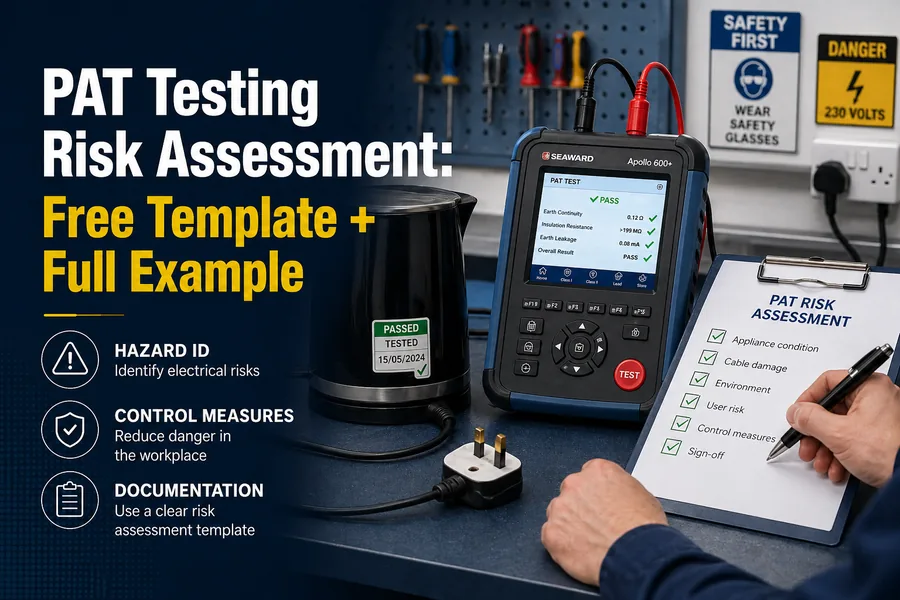
A risk assessment is the document that proves you've genuinely thought through the safety hazards involved in PAT testing — and put controls in place to manage them. It's required under the Management of Health and Safety at Work Regulations 1999, expected by clients and inspectors, and useful as a working tool for any tester.
This post walks through what a PAT testing risk assessment actually needs to cover, gives you a complete worked example, and provides a template structure you can adapt for your own use.
Why risk assessment matters
The Management of Health and Safety at Work Regulations 1999 require employers (and self-employed people in many circumstances) to:
- Identify hazards arising from work activities
- Assess the risks those hazards pose
- Put controls in place to reduce risks
- Record the assessment in writing (where 5+ employees, or where required by other legislation)
Review and update the assessment as conditions change
For PAT testing specifically, risk assessment isn't just bureaucratic — it's a genuine working tool. The act of thinking through "what could go wrong here, and how do I prevent it?" makes you a better tester. The document is the evidence that you've done the thinking.
Who needs a PAT testing risk assessment
You need a written PAT testing risk assessment if you are:
- An employer using PAT testers as employees
- A self-employed PAT tester providing services to others
- A facilities manager or duty holder responsible for PAT testing on premises
- A landlord or HMO operator with PAT testing as part of compliance
The format isn't prescriptive — what matters is that the assessment is complete, current and demonstrably reasoned.
What hazards to cover
A PAT testing risk assessment should cover hazards arising from:
Electrical hazards during testing
- Electric shock from faulty appliances
- Electric shock from incorrectly performed tests
- Damage to test equipment causing inaccurate readings
- Test voltages affecting sensitive equipment
Manual handling
- Moving heavy appliances during testing
- Working in awkward positions to access fixed appliances
- Carrying test equipment between sites
Working at height
- Testing ceiling-mounted equipment (projectors, lighting)
- Working in roof spaces or access cupboards
- Using stepladders during testing
Slips, trips and falls
- Cables across walking routes during testing
- Liquid spills near testing locations (kitchens)
- Cluttered or poorly lit spaces
Fire and burn hazards
- Hot equipment (kettles, heaters, kitchen equipment)
- Equipment overheating during functional check
- Smoke or fire from genuinely faulty appliances
Environmental hazards
- Working in confined spaces (under-stage, under-floor)
- Dusty environments (workshops, building sites)
- Wet environments (kitchens, washrooms)
- Hot environments (commercial kitchens, server rooms)
Lone working
- Working alone with no immediate help available
- Site access issues with single-person testing
- Communications during emergencies
Specific environments
- Construction site hazards
- Healthcare and patient interaction
- School and child protection considerations
- Industrial and machinery hazards
A complete worked example
Here's a fully-developed risk assessment for a typical PAT tester working across mixed commercial and residential premises.
PAT Testing Risk Assessment
HAZARD 1: Electric shock during testing
Who's at risk: PAT tester, third parties present during testing
Risk level: Medium (likely outcome: minor injury; severe outcome possible)
Existing controls:
- All testing performed by competent person (City & Guilds 2377-22 qualified)
- All tests performed using appropriately calibrated PAT testers (within 12 months)
- Visual inspection performed before any electrical testing
- No testing of equipment showing visual signs of severe damage
- Insulated test leads inspected before each session
- Appropriate PPE worn (insulated gloves available where needed)
- All testing performed with appropriate clearance from third parties
Additional controls:
- Nil — controls assessed as adequate
Residual risk level: Low
HAZARD 2: Manual handling injuries
Who's at risk: PAT tester
Risk level: Medium
Existing controls:
- Heavier appliances (>15kg) tested in situ where possible
- Two-person lifts arranged for items >25kg or in awkward positions
- Tester carrying case and trolley used for transport between sites
- Awareness of proper lifting techniques
Additional controls:
- Routine fitness/flexibility maintenance for PAT tester
- Reporting of any injuries to wider team
Residual risk level: Low
HAZARD 3: Working at height
Who's at risk: PAT tester
Risk level: Medium
Existing controls:
- Standard stepladders carried for ceiling-mounted equipment
- Stepladder inspected before each use
- Stable working surface required before stepladder deployment
- No working from ladders for testing requiring two hands free
- Mobile elevating work platforms (MEWPs) hired for high-level access where required
- No working at height in lone-working situations (deferred to scheduled team visit)
Additional controls:
- Annual height-working refresher
Residual risk level: Low
HAZARD 4: Slips, trips and falls
Who's at risk: PAT tester, third parties
Risk level: Low
Existing controls:
- Cables managed during testing — not left across walkways
- Testing stopped if liquid spillage occurs
- Adequate lighting arranged before testing
- Safety signage placed where third parties may pass through testing areas
Residual risk level: Low
HAZARD 5: Fire and burn hazards
Who's at risk: PAT tester
Risk level: Low
Existing controls:
- Recently used hot appliances allowed to cool before testing
- Visual inspection prior to functional check identifies overheating risks
- Testing stopped if appliance shows signs of fire/smoke during functional check
- Fire extinguisher locations identified at testing premises
- Awareness of emergency procedures at each premises
Additional controls:
- Carry small CO2 fire extinguisher in vehicle for serious situations
Residual risk level: Low
HAZARD 6: Lone working
Who's at risk: PAT tester
Risk level: Medium
Existing controls:
- Daily check-in routine with designated contact
- GPS-enabled phone with location sharing during work
- Awareness of premises layout and emergency exit routes
- Avoidance of high-risk lone working scenarios (working at height, confined spaces)
Additional controls:
- Lone working policy formally documented
- Buddy system for high-risk premises (construction sites)
Residual risk level: Low
HAZARD 7: Site-specific hazards
Risk varies by site: Construction, healthcare, schools, industrial each have specific considerations
Existing controls:
- Site-specific risk reviews completed before each new site
- Appropriate PPE for site type (high-vis, safety boots, hard hat for construction)
- Site induction completed at construction sites before access
- DBS check completed for school work
- Adherence to client-specific health and safety policies
Additional controls:
- Site-specific competence training for unusual environments
Residual risk level: Low
HAZARD 8: Stress and mental wellbeing
Who's at risk: PAT tester (lone worker, customer-facing)
Risk level: Low to medium
Existing controls:
- Reasonable scheduling avoiding excessive workload
- Awareness of emotional impact of difficult interactions
- Access to support resources
Residual risk level: Low
Templates for your own assessments
Adapt the above structure for your circumstances. Key fields:
- Tester/Company name
- Date of assessment
- Review date
- Premises type and scope
- For each hazard: who's at risk, current risk level, existing controls, additional controls needed, residual risk
- Tester signature: with date
For multi-site contractors, generic risk assessments cover common hazards while site-specific addenda handle unique situations.
Reviewing and updating the assessment
A risk assessment should be reviewed:
- At least annually
- After any significant incident or near-miss
- When new types of work or equipment are introduced
- When working conditions change significantly
- When there's a relevant change in legislation
Reviews don't have to mean rewriting everything. Often a quick check confirms current controls remain appropriate.
Common mistakes in PAT testing risk assessments
Generic templates without site-specific consideration
A risk assessment that's the same for every site you work at is unlikely to be genuinely useful. The hazards in a busy commercial kitchen are different from those in a quiet office. Tailor your generic assessment for the specific environment you're entering.
Assessments that assume everything is "low risk"
If every hazard is rated low and no additional controls are needed, the assessment isn't being honest about the situation. Specifically electrical hazards in PAT testing should usually be rated medium at minimum because the consequences of failure are serious.
Forgetting customer-facing risks
The risks aren't just to you — they're to clients and others present during testing. Consider lone working scenarios where the appliance owner isn't present, or third parties moving through your testing area.
Out-of-date assessments
A risk assessment from 5 years ago doesn't reflect current testing equipment, current premises conditions, or current legal requirements. Annual reviews are the minimum.
Assessments not communicated to others
If you employ assistants or work in a team, the risk assessment must be communicated to anyone affected by it. A written assessment that nobody else has read is half-useless.
Risk assessments for specific PAT testing scenarios
For an HMO landlord
Cover risks specific to:
- Tenant turnover affecting equipment safety
- Communal area liability
- Specific HMO licence conditions
- Annual compliance reviews
For a school PAT tester
Cover risks specific to:
- DBS clearance and child protection
- School holiday-only access scheduling
- Specialist department equipment
- Coordinating with site staff
For a holiday let testing service
Cover risks specific to:
- Out-of-hours access requirements
- Multiple property scheduling
- Insurance requirements specific to holiday lets
- Booking platform documentation
For a construction site testing service
Cover risks specific to:
- Site induction requirements
- 110V vs 230V testing capability
- Outdoor and weather considerations
- Coordinated testing during operational pauses
Frequently asked questions
Do I need a written risk assessment for PAT testing?
If you're an employer with 5+ employees, yes — required by the Management of Health and Safety at Work Regulations 1999. If you're self-employed, you typically need a written assessment for any work that affects others. Even where not legally required, a written risk assessment is good practice and often required by clients.
How often should a PAT testing risk assessment be reviewed?
Annually as a minimum. Also after any significant incident, when work scope changes, or when relevant legislation changes.
Can I use a generic risk assessment template?
You can start from a template, but it must be tailored to your actual work and premises. A truly generic template that doesn't reflect your circumstances isn't a valid assessment.
Who should sign the risk assessment?
The assessor — typically yourself if you're a sole-trader tester, or the responsible person who carried out the assessment if it's an employer-led assessment. A reviewer or director may also countersign.
Are PAT testing risk assessments accepted as part of the testing certificate?
Generally not — they're separate documents. The PAT testing certificate covers the appliance testing itself; the risk assessment covers the safety of carrying out that testing.
What rating system should I use for risk?
Typically a simple low/medium/high or 1-5 scale based on likelihood and severity. The HSE supports any reasonable system; consistency within your assessments matters more than a specific framework.
Can the risk assessment be electronic?
Yes — electronic risk assessments are entirely acceptable, provided they're complete, accessible to those who need them, and properly maintained.
The takeaway
A PAT testing risk assessment isn't difficult to produce, but it does need to be honest, complete and current. Cover the eight key hazard categories outlined above, adapt them to your specific working circumstances, document your existing controls and any additional controls needed, and review annually.
For most testers, a single written assessment of 5-10 pages covers the standard hazards comprehensively. Site-specific addenda handle unusual situations.
For testers learning the trade, a properly accredited PAT testing course covers risk assessment principles alongside the practical testing — building both into your professional foundation rather than treating them as separate concerns. Risk awareness is what separates competent testers from button-pressers, and a documented risk assessment is the evidence of that awareness.