
%201.svg)


If you're operating as a PAT tester — whether full-time, part-time, or as part of a wider business — proper insurance isn't optional. It's the difference between a manageable bad day and a financially catastrophic one.
This post covers what insurance you actually need as a PAT tester, what each policy protects against, real 2026 prices, and how to handle the specific risks that come with the territory.
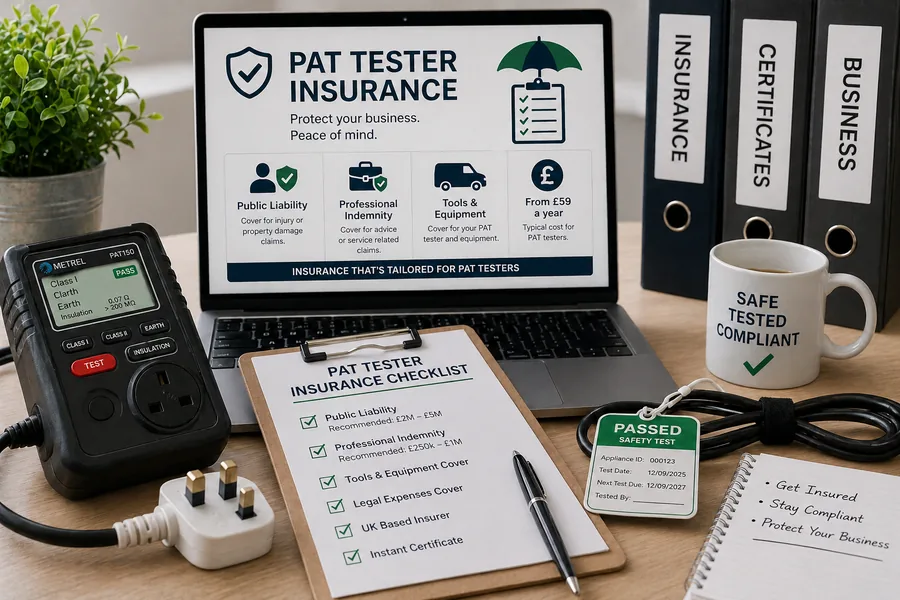
The four types of insurance most PAT testers need
Public liability insurance
The foundation. Covers you if your testing work causes harm or damage to a third party — typically:
- Injury to a client or member of public during your testing
- Damage to client property during testing
- Consequential losses arising from your work
Standard cover levels: £1m, £2m or £5m. Most clients require £2m minimum, particularly for commercial and HMO work.
Professional indemnity insurance
Covers you if your professional advice or services cause financial loss to a client. For PAT testing specifically:
- Failed appliance testing missed during your work
- Incorrect classification of an appliance leading to inappropriate testing
- Errors in certification leading to client compliance failures
- Wrongful advice on testing frequency or appliance disposal
Standard cover: £100k, £250k or £500k. £250k+ is increasingly expected for business-facing work.
Tools and equipment cover
Covers your PAT tester, accessories and any other tools against theft, damage or loss. A mid-range PAT tester is £400-700; calibration costs add £50-80 per year. Replacing equipment from a single theft event without insurance is significant.
Standard approach: separate tools cover (£500-£3,000 covered) or extended coverage as part of business contents insurance.
Vehicle cover (for business use)
If you drive between sites, you need business-use vehicle insurance. Personal car insurance typically excludes "business" use, which can make claims invalid if you have an accident on the way to a site.
Standard approach: business class 1 (occasional business travel) or business class 2 (regular business travel). Class 1 typically adds £50-150 to your normal car insurance; class 2 adds £150-300.
What's not covered
A few things that PAT testers sometimes assume are covered but aren't:
Direct work-related injuries to yourself
Public liability covers injuries to others. If you're injured at a client site testing equipment, your standard insurance won't cover lost income or treatment costs. You'd need separate personal accident or income protection insurance.
Equipment damage caused by faulty testing
If your test damages a client's appliance (rare but possible — particularly with sensitive electronics on full insulation testing), professional indemnity may cover it. Public liability typically won't.
Failure of your own testing skills
Professional indemnity covers errors of professional judgment but doesn't cover deliberate negligence or fraud. If you certify equipment as safe that you knew was dangerous, no insurance will help.
Loss of business if you can't work
Sickness, accident, or family emergency that takes you out of work for weeks isn't covered by any business insurance. Income protection insurance handles this separately.
Typical PAT tester insurance costs (2026)
For a sole-trader PAT tester operating in the UK:
- Public liability £2m: £120-£250 per year
- Professional indemnity £250k: £150-£350 per year
- Tools and equipment cover (£2,000): £80-£150 per year
- Vehicle business class 1 upgrade: £50-£200 per year
- Combined policy package: £350-£800 per year
Most PAT testers with established businesses pay around £400-£600 per year for comprehensive cover.
For higher-risk specialisations (construction, healthcare, large-scale industrial), expect 30-50% higher premiums due to the increased exposure.
What insurance providers ask about
When applying for PAT tester insurance, expect questions about:
- Your qualifications (City & Guilds 2377-22 or equivalent)
- Years of experience
- Annual revenue from PAT testing
- Maximum value of equipment you typically work on
- Types of premises you work in (commercial, residential, industrial, special)
- History of any previous claims
- Whether you provide professional indemnity-relevant advice (testing frequency recommendations, equipment classifications, etc.)
- Geographic area of operation
Honest answers reduce the risk of policy dispute later. Cheap insurance from a comparison site that didn't ask the right questions is the worst-of-all-worlds because cover may be invalid when you need it.
Working without insurance
Some PAT testers — particularly cash-in-hand operators — work without proper insurance. The financial logic on the surface looks attractive: £400-600 per year not paid is direct profit.
The reality is starkly different:
Catastrophic claims
A single fire traceable to an appliance you certified as safe could lead to:
- £100k+ damages (typical commercial fire)
- Personal liability where you're held responsible
- Loss of all personal assets
Client losses
Most professional clients (commercial, HMO, holiday lets, schools) require evidence of insurance before engaging you. Without it, you simply can't compete for that work.
Personal risk
Even for sole-trader work, an accident or negligence claim against your name is yours personally, not just business-related. Without insurance, judgments against you become personal debts.
The honest math: insurance costs about £500/year. A single small claim can easily reach £10,000+. The break-even point is being right less than 5% of the time.
Special considerations
Insurance for trainees and new testers
If you're newly qualified, some insurers will quote you at standard rates because they assess based on qualification rather than experience. Others offer specialist "newly qualified" rates with appropriate caveats.
Insurance for part-time PAT testers
If PAT testing is a sideline alongside other work, dedicated specialist insurers offer "part-time tradesperson" policies that combine PAT testing cover with whatever your main work is. These often work out cheaper than separate policies.
Insurance for limited companies
Limited company PAT testing operations face similar requirements but with directors' liability cover added. Annual costs typically £500-1,000 for comprehensive cover.
Insurance for multi-tester operations
If you employ other testers, employers' liability insurance becomes mandatory. Add £150-300 per employee per year, depending on payroll and risk profile.
Specialist insurance for high-risk environments
If you work primarily in:
- Construction sites: specialist construction industry insurers often quote better rates
- Healthcare: healthcare-aware insurers handle the additional complexity
- Schools: education-aware insurers understand the school-specific issues
- Heritage and listed buildings: heritage-aware insurers handle conservation requirements
Run-off cover
If you stop trading, claims can still arise from past work for years afterwards. "Run-off cover" provides ongoing protection for past work after you've ceased active operation. Often included in retirement-ready policies, sometimes a separate purchase. Plan for £200-400/year for 3-5 years after retirement.
How to choose an insurer
When comparing PAT tester insurance:
- Specialist vs general: specialist tradesperson insurers usually price better than generalist providers
- Trade body affiliation: NAPIT, Stroma, ECA and other trade body associations often discount premiums
- Compare cover levels, not just prices: a £150 premium with £100k professional indemnity is worse than £250 with £500k
- Check exclusions carefully: some policies exclude specific types of work (3-phase, healthcare, etc.) that you might do without realising
- Read the claims process: a fast-claims insurer is worth significantly more than a cheap one with awkward processes
- Ask about excess: low premium with £500 excess is worse than higher premium with £100 excess for routine claims
The role of qualifications in insurance
Most insurers require a recognised qualification — typically City & Guilds 2377-22 or equivalent — before issuing professional indemnity cover. Without the qualification, your options narrow significantly:
- General trade insurance covering "PAT testing" without specific competence verification
- Higher premiums (typically 25-50% above qualified rates)
- More restrictive cover
The combination of a recognised qualification and proper insurance is what professional clients expect — and what most clients require for any work over £100. If you're starting out, completing an accredited PAT testing course and securing proper insurance are the two foundational steps that justify charging professional rates.
Documentation requirements
Insurance policies require you to maintain certain documentation:
- Calibration certificates for your testing equipment
- Records of all testing work (in line with PAT testing record-keeping requirements)
- Proof of qualifications (typically renewable every 5-10 years)
- Vehicle insurance documentation
- Health and safety policies for your business
Loss of any of these can compromise an insurance claim. Maintain electronic records with backups.
Frequently asked questions
Do I need insurance for PAT testing?
If you're testing as a paid service for others, yes — public liability insurance at £2m minimum and professional indemnity at £250k minimum are practically required. Without insurance, most clients won't engage you and you face catastrophic personal liability.
How much is PAT testing insurance per year?
Comprehensive cover for a sole-trader PAT tester typically costs £400-600 per year. Specialist work (construction, healthcare) and limited companies cost more.
Can I PAT test without public liability insurance?
You can test for yourself or your own employer without it. As soon as you provide PAT testing as a service to anyone else, insurance becomes practically essential — and is often required by clients before engagement.
What's the minimum public liability cover I should have?
£2m is the practical minimum for most commercial work. £5m is standard for higher-risk environments and many tender-led commercial work.
Does my home insurance cover PAT testing equipment?
Typically not. Home insurance excludes business equipment used for paid work. Tools and equipment cover specifically for business use is needed.
Do I need professional indemnity insurance as well as public liability?
For most PAT testers, yes. Public liability covers injury and damage; professional indemnity covers professional advice and certification. Different risks need different cover.
Can I get insurance without PAT testing qualifications?
Possible but expensive. Most insurers require recognised qualifications (City & Guilds 2377-22 or equivalent) for standard professional indemnity cover. Without qualifications, premiums are 25-50% higher and exclusions are more restrictive.
The takeaway
PAT tester insurance is mandatory in any practical sense. Public liability at £2m, professional indemnity at £250k, tools cover, and business vehicle cover form a comprehensive £400-600 per year package that protects you from career-ending claims.
The single most common insurance mistake among new testers is thinking they can save money by skipping it. The math is clear: a single fire claim, a client appliance damaged during testing, or a serious injury during your work can easily reach tens of thousands of pounds in damages. Insurance is the cheap way to never face that personally.
If you're newly qualified or starting your testing business, complete a proper PAT testing course, set up your insurance immediately afterwards, and treat it as part of your professional foundation — alongside the qualification and the equipment itself. The combination is what makes paid testing work viable and sustainable.