
%201.svg)


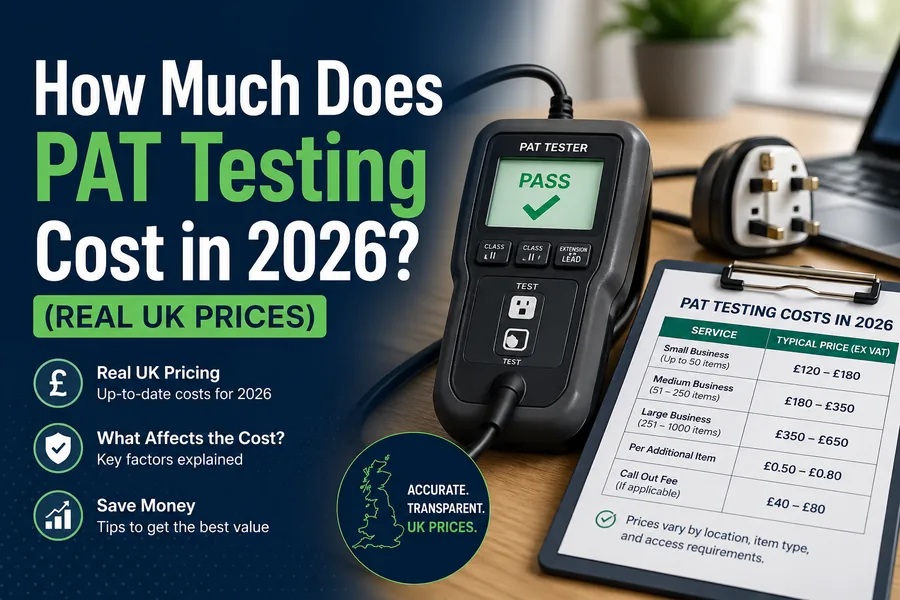
There's no single "PAT testing price" for the UK market. Costs vary by region, contractor type, appliance count, complexity of the premises and how you're sourcing the testing — and the same testing job quoted by three different contractors can come back at quite different numbers.
This post walks through the actual price ranges in 2026, what drives the variations, and how to think about whether outsourcing or doing it in-house makes more financial sense for your situation.
The headline numbers
For typical UK PAT testing in 2026:
- Per-item rates from external contractors: £1.00 to £2.00 per appliance
- Minimum call-out fees: £40 to £80 for most contractors
- Small business / single visit: £60 to £150 typical
- Mid-sized business (50-200 items): £150 to £350 typical
- Large business or multi-site: bespoke pricing, usually negotiated annually
These are mid-market prices for accredited contractors. Cheaper exists (cash-in-hand testers at £0.50 per item or less); premium exists (national specialists at £3+ per item with bundled services). Both extremes carry their own trade-offs.
What drives PAT testing pricing
Number of appliances
Per-item rates drop as volume increases. A contractor testing 50 items charges proportionally more per item than the same contractor testing 500 items. Typical price tiers:
- 1-50 items: £1.50-£2.00 per item
- 51-200 items: £1.20-£1.60 per item
- 201-500 items: £1.00-£1.40 per item
- 500+ items: negotiated, often £0.80-£1.20 per item
Minimum call-out fee
This is what hits small premises hardest. A contractor visiting a property to test 15 items still has to drive there, set up, and process the results. Most charge a minimum of £40-80 regardless of item count. For a 15-item property, that minimum fee can mean an effective rate of £3-5 per item.
Geographic location
Rates vary regionally:
- London and South East: typically 20-30% above national average
- Major cities (Manchester, Birmingham, Leeds): in line with national average
- Rural areas: often cheaper per-item rates but higher minimum call-outs because of travel time
- Remote rural areas: significant call-out premiums (mileage and time)
Type of premises
Some premises types attract premium pricing:
- HMOs and licensed properties: 10-20% premium for the additional documentation requirements
- Holiday lets: similar premium plus weekend availability charges
- Construction sites: significant premium for site safety requirements and 110V capability
- Healthcare and education: premium for appropriate clearances and child/vulnerable adult considerations
- Industrial facilities: premium for 3-phase and specialist equipment capability
Speed of service
Same-day or next-day visits cost more than scheduled testing 2-4 weeks out. Emergency callouts (after a failed inspection or pre-inspection) can be 50-100% over standard rates.
Reporting format
Standard certificates are included in basic pricing. Premium reporting adds:
- Detailed digital reports: typically £20-50 per visit extra
- Branded reports for landlords/businesses: similar
- Software platform integration: subscription model alongside testing fees
- Photo documentation of failed items: usually £20-30 per visit extra
Failed item handling
What happens to failed items varies:
- Tag and notify: included in standard pricing — failed items labelled, business handles repair/replacement
- Repair on-site: typically £15-30 per item (basic plug/fuse replacement)
- Replace on-site: cost of replacement plus markup
- Disposal of failed items: often £5-10 per item
Calibration certificates
Standard PAT testing includes confirmation that the tester is calibrated. If you need formal calibration certificate copies for audit purposes, expect £10-20 extra per testing round.
Typical real-world quotes
Some illustrative scenarios:
Small office (15 items)
- Contractor minimum call-out: £60
- Effective rate: £4 per item
- Total cost: £60
Standard office (80 items)
- Per-item rate: £1.40
- Total: £112
- Possible minimum call-out: £80
- Final cost: £112
Restaurant (120 items)
- Per-item rate: £1.30
- Total: £156
- Often with same-day reporting: £180
HMO (40 items)
- Per-item rate: £1.50 (HMO premium)
- Minimum call-out: £60
- Final: £60-80
4-bedroom holiday cottage (60 items)
- Per-item rate: £1.40
- Total: £84
- Annual frequency required: £84/year
Mid-size manufacturing site (400 items)
- Per-item rate: £1.10
- Total: £440
- Often discounted for annual contract: £400-440
Secondary school (3,000 items)
- Per-item rate: £0.90 (volume rate)
- Total: £2,700
- Spread across 4-6 testing days during holidays
Construction site (200 items, 110V tools)
- Per-item rate: £2.00 (specialist premium)
- Plus minimum daily fee for site presence: £150-200
- Total per visit: £400-600
- Quarterly retesting: ~£1,600-2,400/year
The hidden costs that contractors don't always quote
Watch for these in quotes:
- Re-test of failed items: some contractors charge full per-item rate for retest after repair
- Travel and mileage: usually included for local work, charged separately for distant sites
- Weekend or after-hours premiums: 25-50% surcharge for non-standard hours
- Detailed photography or documentation: variable
- Cancellation fees: typically 50% of the visit fee if cancelled within 48 hours
Always get an itemised quote and confirm:
- Per-item rate (with quantity tier specified)
- Minimum call-out fee
- What the price includes (basic certificate? detailed report? failed-item handling?)
- Travel charges
- Re-test policy after failed items
In-house testing: the cost model
The other cost-conscious option: train a member of staff and bring testing in-house.
Initial costs
- Accredited PAT testing course: £150-250 (one day)
- Mid-range PAT tester: £400-700
- Tester accessories: £50-100 (carry case, leads, labels)
- Tester calibration certificate: usually included with new tester
- Software (optional): £100-300 one-off, or subscription
Total upfront cost: £600-1,250 for a complete in-house setup
Ongoing costs
- Annual calibration: £40-80 per year
- Replacement labels: £20-30 per year
- Tester replacement: every 8-12 years, £400-700
- Refresher training (every 5-10 years): £150-250
- Time of staff member testing: salary-cost depending on role
Annual ongoing cost: £100-200 plus staff time
Break-even analysis
For an in-house tester, the break-even point compared to outsourcing is when:
(Annual outsourcing cost) > (Annual in-house cost + apportioned upfront cost)
For most UK businesses, this means in-house is cheaper if you're testing more than ~80-100 items annually. For HMO portfolios, holiday let portfolios, schools, manufacturing facilities and any site with 200+ regular items, in-house typically saves significant money.
Comparing 5-year totals for a 200-item business
Outsourced (typical):
- Annual: £240 (200 × £1.20)
- 5 years: £1,200
- Plus inflation/price increases: ~£1,400 total
In-house (typical):
- Initial: £900
- Annual ongoing: £150
- 5 years: £900 + (£150 × 5) = £1,650
- Or with continued use beyond 5 years: cheaper than outsourcing
The math gets clearer with higher volumes. For a 1,000-item business:
Outsourced:
- Annual: £1,200 (1,000 × £1.20)
- 5 years: £6,000+
In-house:
- Initial: £1,000
- Annual: £200
- 5 years: £2,000
That's £4,000+ savings over 5 years for a single in-house tester.
When outsourcing genuinely makes sense
Despite the cost case for in-house, outsourcing remains the right answer for:
- Truly small premises: under 50 items where contractor minimums apply
- Single annual visits: where the testing is a once-a-year box-tick
- Premises requiring third-party verification: where the audit value of an external certificate matters
- Businesses with no maintenance staff: where there's nobody appropriate to train
Hidden cost: the cost of getting it wrong
A separate consideration: what happens if testing isn't done properly?
- Insurance refusal after an incident: potentially tens of thousands of pounds
- Civil liability for injuries: unlimited
- Regulatory penalties: up to £30,000 per HMO breach, unlimited for HSW Act
- Loss of HMO licence or rental authorisation: business-ending in some cases
These aren't directly the cost of testing, but they're the cost of NOT testing properly. Cheap testing that misses faults is often more expensive than no testing at all in the long run, because the bad records create a false sense of compliance.
How to negotiate better PAT testing pricing
If you're outsourcing:
- Get 3+ quotes for any visit over 50 items
- Ask about volume discounts explicitly
- Confirm what's included — re-tests, certificates, travel
- Ask about annual contracts for ongoing relationships
- Combine testing with EICR if both are due (often discounted)
- Be flexible on dates — weekend and emergency premiums add up
- Ask for itemised quotes rather than headline numbers
For in-house testing:
- Buy quality once rather than cheap repeatedly
- Choose courses with hands-on practice (most accredited courses)
- Build the asset register thoroughly in year 1 to maximise efficiency in subsequent years
- Schedule testing efficiently — batch similar items together
Frequently asked questions
How much does PAT testing cost per item?
UK PAT testing typically costs £1.00-£2.00 per item from external contractors. Volume discounts apply at scale (£0.80-£1.20 per item for 500+ items). Minimum call-out fees of £40-80 mean small jobs have higher effective rates.
How much does it cost to PAT test a house?
For a typical 4-bedroom rental property with 30-40 appliances, expect £60-120 from a contractor — usually hitting the minimum call-out fee. HMOs are typically 10-20% more.
Is it cheaper to do PAT testing yourself?
For testing more than ~80-100 items annually, yes. Initial setup (course + tester) is £600-1,000, recoverable in 1-3 years compared to outsourcing for most businesses with regular testing needs.
How much does a PAT testing course cost?
Accredited one-day courses (City & Guilds 2377-22 or equivalent) are typically £150-250 in the UK. Some providers bundle a tester at extra cost.
How much does a PAT tester cost?
Pass/fail testers start at £150-£400. Mid-range downloading testers (the sweet spot for most users) are £400-£1,000. Top-tier professional testers run £1,000-£2,500+. See our PAT testing equipment guide for buyer's guidance.
Why is PAT testing so cheap from some companies?
Below £1 per item often indicates: cash-in-hand operation without proper insurance, untrained or inadequately qualified testers, rushed work missing visual inspections, or use of old/uncalibrated test equipment. Cheap testing that misses faults costs more in the long run.
How often does the cost of PAT testing recur?
Frequency is risk-based. Most office equipment is on 24-48 month cycles, meaning costs recur every 2-4 years. Higher-risk environments (kitchens, schools, construction) recur more often. See our PAT testing frequency post.
The takeaway
UK PAT testing in 2026 typically costs £1-2 per item from a contractor, with a £40-80 minimum call-out. For small one-off jobs, that's the cheapest route. For anything regular — HMO portfolios, holiday lets, schools, larger businesses — training in-house through a proper PAT testing course usually pays back within 1-3 years.
The real cost of PAT testing isn't the per-item rate. It's the cost of doing it properly enough to actually catch faults, document compliance, and stand up to scrutiny if something ever goes wrong. Cheap testing that misses faults is the most expensive option of all.
Get multiple quotes, compare like-for-like, and consider whether the volume justifies bringing it in-house. For most UK businesses with more than a handful of premises or appliances, the answer is yes.