
%201.svg)


The most widespread myth about PAT testing in the UK is that everything needs testing every year. It's wrong — and believing it probably costs British businesses millions of pounds a year in unnecessary retesting.
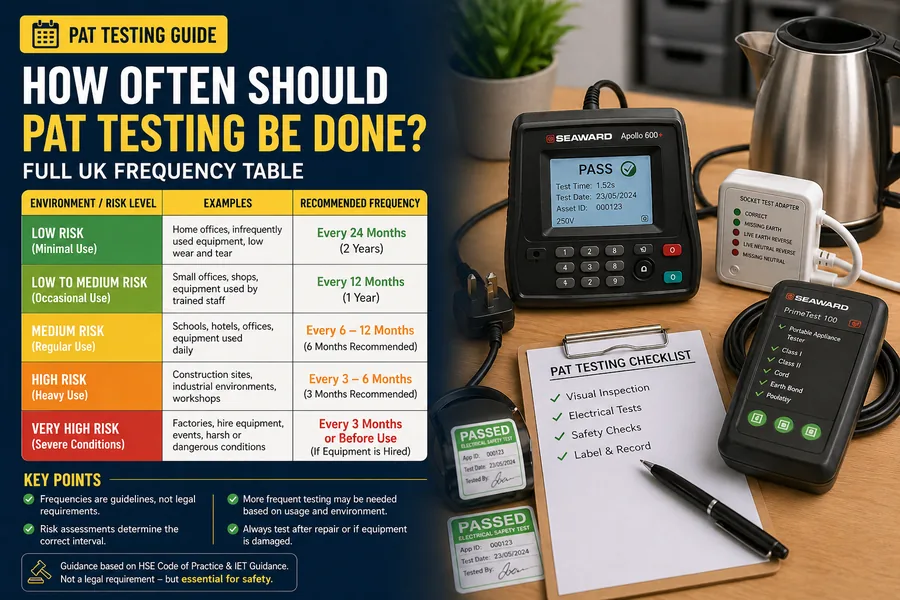
The HSE's own guidance is clear: PAT testing frequency should be based on risk, not on a calendar. A handheld drill on a building site needs checking every three months. A printer in a quiet office might only need checking every four years. Treating them the same is inefficient at best and, in the wrong direction, genuinely unsafe.
Below is the full UK frequency guidance — with a proper table — along with how to work out the right interval for your own premises.
The core principle: testing frequency is risk-based
The IET's Code of Practice for In-service Inspection and Testing of Electrical Equipment (currently in its 5th edition) sets out the recommended testing intervals that nearly everyone in the industry follows. Those intervals depend on three things:
- The type of environment — construction sites carry far more risk than offices
- The type of appliance — handheld tools get moved, dropped and knocked; stationary kit doesn't
- The class of appliance — Class 1 (earthed) equipment has tighter intervals than Class 2 (double-insulated) equipment
Combined, those three factors give you a recommended interval. It's not a legal requirement to follow the IET intervals exactly, but they are the accepted industry standard — and following them is the simplest way to demonstrate a reasonable approach to compliance. We explain why compliance matters in our detailed guide on whether PAT testing is a legal requirement.
The three types of check
Before getting to the table, it's worth understanding that PAT testing isn't a single activity. The IET splits it into three:
User checks
These are informal visual checks done by the person using the equipment — looking at the plug, cable and casing for obvious damage before use. There's no paperwork required, and users aren't expected to be formally trained. User checks are done every time the equipment is used, or at least regularly in active workplaces.
Formal visual inspections
A more thorough visual inspection carried out by a competent person (who could be the same person as the tester, or a separately trained inspector). This covers everything a user would notice plus more detailed checks — plug interior, fuse rating, correct appliance class, suitable environment. No testing equipment is needed. Formal inspections are typically done at a higher frequency than combined testing.
Combined inspection and testing (a full PAT test)
Everything above, plus the electrical tests carried out by a PAT tester — earth continuity, insulation resistance, polarity and so on. This is what most people mean by "PAT testing." The frequencies in the table below refer to this combined test.
The full UK PAT testing frequency table
These are the intervals from the IET Code of Practice, grouped by environment. Intervals show months between full combined tests.
Construction sites
Construction is the highest-risk environment — wet conditions, impact damage, frequent movement of equipment.
Appliance typeClass 1Class 2110V portable tools and handheld equipment3 months3 months230V portable equipment (including extension leads)3 months3 months230V stationary and fixed equipment6 months6 months
Construction sites also typically require quarterly formal visual inspections in addition to the above.
Industrial sites and workshops
Includes factories, commercial kitchens, mechanical workshops and similar settings.
Appliance typeClass 1Class 2Handheld tools and portable equipment6 months12 monthsMovable equipment12 months24 monthsStationary and fixed equipment12 months24 monthsIT equipment24 months24 months
Equipment used by the public (hotels, shops, restaurants, leisure venues)
Where members of the public use or are exposed to the equipment.
Appliance typeClass 1Class 2Handheld equipment12 months24 monthsPortable equipment12 months24 monthsMovable equipment24 months24 monthsStationary/fixed equipment24 months48 monthsIT equipment24 months48 months
Schools (and other educational settings)
Schools are treated as a higher-risk category than standard offices due to children being around the equipment.
Appliance typeClass 1Class 2Handheld equipment12 months48 monthsPortable equipment12 months48 monthsMovable, stationary and fixed48 months48 monthsIT equipment48 months48 months
Classroom equipment used by pupils — particularly in D&T, science and music departments — often warrants more frequent informal visual inspection. Our PAT testing in schools post covers the practicalities.
Offices and low-risk commercial environments
The most common category — offices, estate agents, solicitors, professional services.
Appliance typeClass 1Class 2Handheld equipment24 months48 monthsPortable equipment24 months48 monthsMovable equipment48 months48 monthsStationary and fixed equipment48 months60 monthsIT equipment48 months60 months
Yes — a desktop PC in a typical UK office doesn't need combined testing for up to four years. User checks and occasional formal visual inspections fill the gap.
Rental properties
For standard buy-to-let residential rentals, PAT testing every tenancy change or every 2 years (whichever is sooner) is the widely accepted approach. HMOs and holiday lets follow different patterns — see our separate posts on PAT testing for landlords, HMO PAT testing and PAT testing for holiday lets.
Equipment hire
Any electrical equipment hired out to customers — power tools, event equipment, marquee kit — should be inspected and tested before every hire, in addition to the interval tests appropriate to its class and type.
Quick reference: appliance type definitions
If you're wondering why "portable," "movable," "handheld" and "stationary" matter — each has a specific meaning in PAT testing terminology:
- Handheld — used while being held (drills, kettles, hairdryers, irons)
- Portable — less than 18kg, intended to be moved while in use (microwaves, toasters, small desk fans)
- Movable — 18kg or less, not designed to move during use but easily picked up (small fridges, desktop PCs)
- Stationary — over 18kg, not normally moved (photocopiers, large printers, commercial cookers)
- Fixed — fastened to a support or otherwise secured in a location (wall-mounted heaters, hand dryers)
- IT equipment — handled as its own category, generally lower-risk than similar industrial equipment
The class of appliance — Class 1 or Class 2 — is a completely different distinction based on how the appliance protects against electric shock. Our Class 1 vs Class 2 guide explains the difference with examples.
How to work out the right interval for your own premises
If your environment doesn't fit neatly into one of the categories above, you need to do a short risk assessment and come to your own conclusion. The HSE specifically supports this approach. Consider:
- How often is the equipment moved? More movement = more chance of cable damage
- How harsh is the environment? Damp, dusty, hot, vibration-exposed environments damage equipment faster
- Who uses the equipment? Untrained users, children or the public create higher risk than trained staff
- What's the consequence of a failure? An industrial heater failing is different from a desk lamp failing
- What does the manufacturer recommend? Some appliances have specific maintenance intervals
Your conclusion might be that the IET's office intervals are fine, or that certain appliances need tighter intervals than the defaults. Either way, write it down. A documented risk-based rationale for your testing frequency is what the HSE and your insurer want to see. We cover documentation in our post on PAT testing risk assessments.
Common mistakes businesses make on frequency
Testing everything annually. If you're paying a contractor to test every item in a low-risk office each year, you're almost certainly paying for unnecessary work. Most office IT equipment is on a 48–60 month cycle.
Using the same interval across different environments. A building company with both an office and an active site should absolutely not be using the same frequency for both.
Forgetting equipment hired in or brought by staff. Any equipment being used on your premises is your responsibility — including employees' personal kit (chargers, desk fans, kettles brought in for the kitchen). It should all be included in the regime.
Not documenting the rationale. If your frequency is different from the IET defaults, the difference itself isn't a problem — but not being able to explain why it's different is.
Frequently asked questions
How often should PAT testing be done in an office?
For standard office environments, IT equipment and stationary items typically need combined testing every 48–60 months. Handheld and portable items (kettles, desk fans, phone chargers) fall on a 24–48 month cycle depending on class.
Is PAT testing required annually?
No. Annual testing is a myth. The HSE explicitly says frequency should be risk-based and that many appliances don't need yearly testing. The IET Code of Practice sets out intervals from 3 months (construction) up to 60 months (office IT) depending on environment and appliance.
How often do PAT tests need to be done for landlords?
The widely accepted standard is every 2 years, or at every change of tenancy (whichever is sooner). HMOs often need more frequent testing due to higher turnover and shared use.
Do PAT testing certificates expire?
Technically no — a certificate is a record of a test on a specific date. What "expires" is the validity of that test for your ongoing compliance, which depends on your testing interval. If your interval is 24 months, the test is out of date 24 months and a day after it was carried out.
How often does new equipment need PAT testing?
New equipment generally only requires a formal visual inspection before first use — not a full combined test. It then enters your normal testing regime at the appropriate interval. See our post on PAT testing new appliances for the exceptions.
Where training fits in
If you're managing testing frequency decisions for a company — especially one with multiple sites or mixed environments — having somebody in-house who genuinely understands the IET code saves significant money over time. A competent in-house tester can make risk-based frequency decisions, rather than defaulting to "everything annually" just to be safe.
A recognised PAT testing qualification gives you exactly that understanding, along with the practical skills to handle the testing itself. For organisations with enough appliances to justify it, the course typically pays for itself in the first year alone through better-targeted testing intervals.
The bottom line
PAT testing frequency is risk-based, not calendar-based. The IET Code of Practice gives you sensible default intervals for common environments — from 3 months on construction sites to 60 months for some office equipment. Apply the defaults, document the decisions and adjust where your risk assessment shows you should. That's the whole of it.