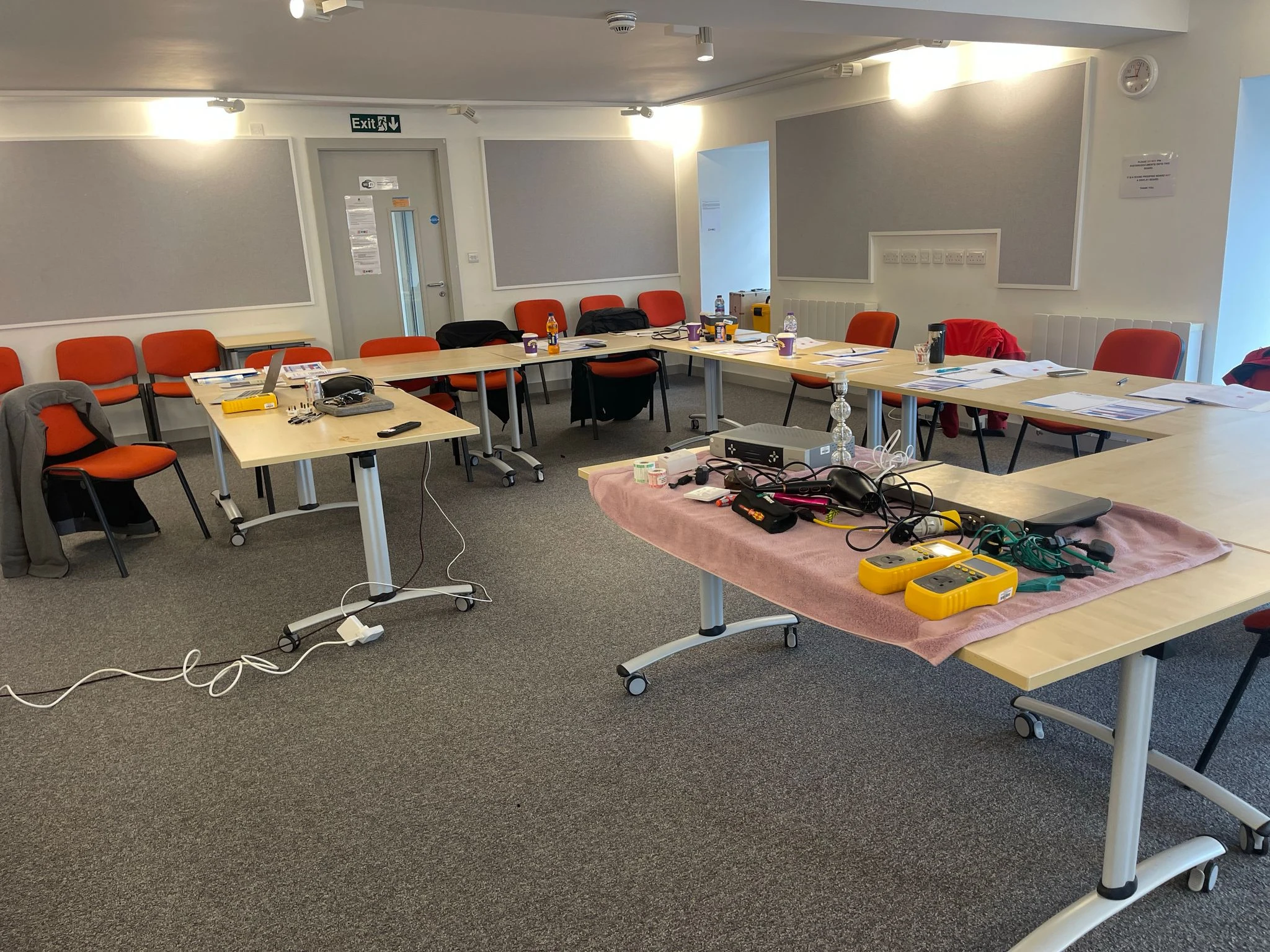
Train your team together, with a Skills Training Group instructor at your premises.
A one-day practical course for up to 12 learners. We bring the PAT testers; your team learns to inspect appliances, carry out the appropriate tests and record the results.
Bring the course to the people using the equipment
In-house PAT training can suit facilities and maintenance teams, schools, property businesses and other organisations responsible for portable electrical equipment. Colleagues learn the same inspection and testing process, with time to discuss the appliances they encounter at work.
Training at your venue means your staff can attend together without travelling to a public course. Your instructor can discuss questions about your working environment while covering the full syllabus and assessing each learner individually.
No previous electrical qualification or PAT testing experience is required. The course is suitable for learners aged 18 and over, including staff taking on appliance checks for the first time.
What you provide, and what we bring
We will check the venue and practical arrangements with you before the training day.
Your training space
A suitable room with seating for everyone attending.
Access to mains plug sockets for the practical work.
A selection of portable electrical appliances to inspect and test.
Details of any access restrictions or learner support needs.
Our instructor and equipment
A Skills Training Group instructor to deliver the course.
PAT testing equipment for use during the session.
Demonstrations, supervised practice and individual assessment.
A digital certificate for each learner who passes.
Already have a PAT tester? Send us the make and model so we can discuss using your equipment during the course.
What your team will learn
The course follows the IET Code of Practice and combines the reasons for each check with practical experience of carrying it out.
Recognise risks and inspect appliances
Understand electrical hazards and appliance classifications. Examine plugs, cables and casings, and identify concerns that a tester reading alone might not reveal.
Select and carry out appropriate tests
Practise using the PAT tester with instructor guidance. Work through earth continuity, insulation resistance and other relevant checks, following safe procedures for the equipment being tested.
Understand the result
Connect the test reading with the visual inspection. Learn how to make pass or fail decisions and recognise when an appliance needs further attention.
Keep useful records
Record inspection and test results, identify the equipment checked and consider how use and environment affect future inspection and testing arrangements.
Assessment and certificates for your team
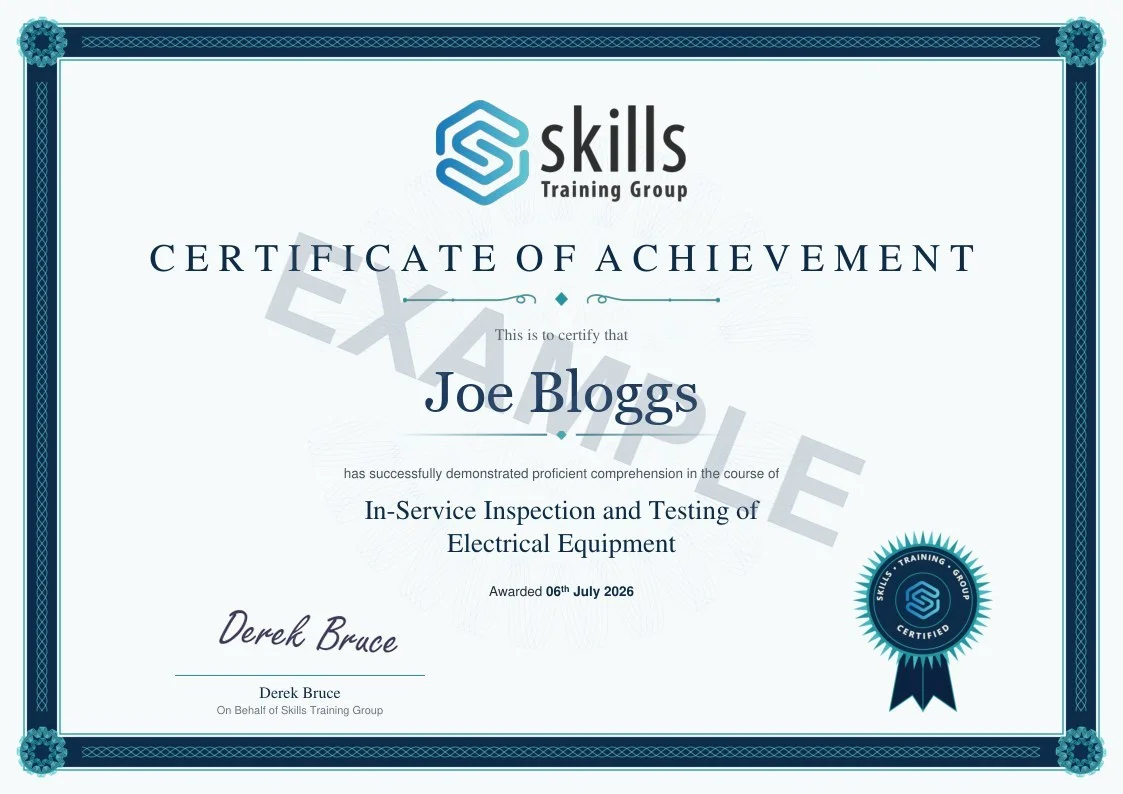
Example certificate. Yours shows your name and award date.
Each learner completes a supervised practical assessment and a short multiple-choice knowledge check. The instructor assesses their inspection and testing technique, safe working and understanding of the results.
Successful learners receive a digital Skills Training Group PAT testing certificate by email within one working day. It records completion of the training and assessment; it is a provider-issued certificate rather than a regulated City & Guilds qualification.
If your organisation or a customer has specified a particular qualification, check that requirement with us before booking. This course covers portable appliance inspection and testing, not electrical installation or fixed-wiring work.
Free reassessment is available if a learner does not pass. The course also carries a money-back guarantee if they cannot meet the required assessment standard; contact the team about the arrangements.
A live online course for your group
If your colleagues are based in different locations, ask about a private instructor-led Zoom course for up to eight learners.
The group price is £834 including VAT (£695 excluding VAT). Each learner needs access to a PAT tester for the supervised practical work, along with the equipment needed to join the online session.
Everything people ask us before booking, in one place.
Need help with your circumstances?0808 164 2780Freephone · Mon–Fri 8:30am–5pm
Arranging your course
How many people can attend?
The on-site course accommodates up to 12 learners in one session. If you have a larger team, tell us the total number and any shift patterns so we can discuss additional sessions. Private live online groups can accommodate up to eight learners.
What does the group price include?
The on-site course is £900 including VAT (£750 excluding VAT) for a group of up to 12, plus travel and accommodation if required. This includes instructor-led training, use of PAT testing equipment, assessment and a digital certificate for each successful learner. Your team does not receive a PAT tester to keep. We will confirm your venue, dates and arrangements when preparing your booking.
Is workplace training worthwhile for a smaller team?
You do not need to fill all 12 places. Compare the group price with the number of public course places you need, as well as the time and travel involved. For one or two learners, a local classroom course may be the better fit. We can help you compare the options.
You can propose a workplace or another suitable training venue. Tell us the full address, available room and facilities so we can check the arrangements before you commit to a booking.
Can we choose the date and start time?
Send your preferred dates and any shift or opening-hour constraints. The team will confirm trainer availability and agree the course timetable with you. The training and assessment take one full day; a date is not reserved by making an enquiry.
Can we train staff across several sites?
Yes, ask us about arranging sessions at your different premises or bringing colleagues together at one venue. Send the locations and learner numbers for each site so we can discuss a practical schedule.
Equipment and assessment
Do we need to buy PAT testers before the course?
No. Testing equipment is supplied for the on-site practical session. If your staff already use a particular tester, tell us its make and model when enquiring so we can discuss using it during training. A tester to use afterwards is a separate purchase.
What do we need to provide?
Provide a suitable training room with seating for every learner, mains plug sockets and a selection of portable electrical appliances for the practical exercises. Tell us about access restrictions or learning requirements in advance. We will check the arrangements with you before the course.
Do I need to be an electrician or have previous experience?
No. There are no previous electrical qualifications or experience required. The course starts with the basics, then moves into demonstrations and guided practice. It suits maintenance and facilities staff, landlords, property managers, tradespeople and people learning PAT testing for the first time.
Is there an exam, and what will I have to do?
Assessment includes a supervised practical exercise and a short multiple-choice knowledge check. You demonstrate safe inspection and testing, correct use of the tester and an understanding of the results. The practical work during the course gives you an opportunity to develop these skills before assessment.
When and how will I receive my certificate?
Your digital certificate is emailed within one working day of successfully completing the course and assessment. Check that your learner name and email address are correct when booking. If it has not arrived after that time, check your spam folder and contact the team.
Who issues the certificate, and is it a City & Guilds qualification?
Successful learners receive a Skills Training Group PAT testing certificate recording their training and assessment. This is a provider-issued training certificate, not a regulated City & Guilds qualification. The content follows the IET Code of Practice. If an employer or customer specifies a particular qualification, check that requirement before booking.
Read our learners’ reviews
Independent feedback on Skills Training Group’s courses and services, including courses beyond PAT testing.