
%201.svg)


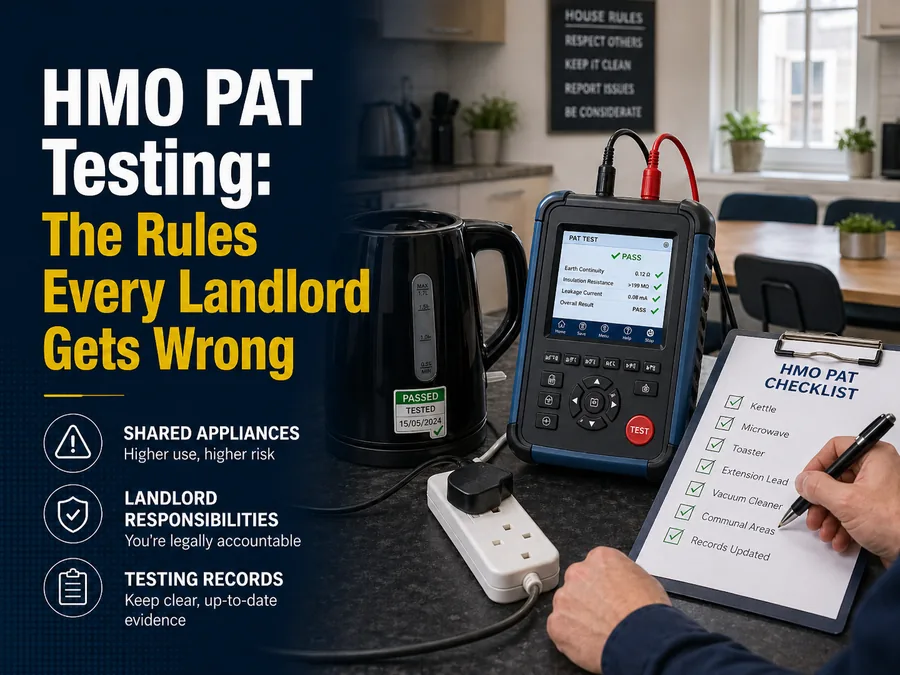
Houses in Multiple Occupation (HMOs) sit in a different legal category from standard buy-to-lets — and PAT testing is one of the areas where the difference matters most. Most landlords coming from a standard rental background don't realise that HMO PAT testing is, in many councils, an explicit licence condition. Skip it and you can lose your licence, face fines, or be banned from letting altogether.
This post covers what the rules actually say, how local authority licensing varies, what to test in an HMO, how often, and the practical realities that make HMO testing different from standard residential.
What counts as an HMO?
The legal definition of an HMO under the Housing Act 2004 is broadly: a property occupied by three or more people forming two or more households who share basic amenities (kitchen, bathroom, toilet).
In plain English:
- A house shared by three friends from different families = HMO
- A house let to one family of any size = not an HMO
- A house let to two unrelated people = not an HMO (single household equivalent)
- A house let to a couple plus their adult lodger = HMO if the lodger is a separate "household"
- Student houses, professional houseshares, and most multi-tenant lets = HMOs
Whether your property requires a licence is a separate question — that depends on size, occupancy and local authority rules.
Mandatory licensing vs additional/selective licensing
There are three licensing regimes that can apply:
Mandatory HMO licensing (England and Wales)
Properties occupied by 5+ people across 2+ households must be licensed. This is national legislation — no postcode lottery.
Additional HMO licensing
Local authorities can extend licensing to smaller HMOs (3-4 occupants) in their area. Around 80 English councils currently operate additional licensing schemes. Wales operates similar schemes.
Selective licensing
Some councils require all rental properties (HMO or otherwise) in designated areas to be licensed. Currently in force in around 50 English council areas.
The licensing regime that applies to your property determines the specific PAT testing requirements baked into the licence conditions.
What HMO licence conditions typically say about PAT testing
This is where HMOs differ most clearly from standard residential lets. Most HMO licences include explicit electrical safety conditions, which typically require:
- An electrical installation condition report (EICR) every 5 years
- Annual PAT testing of all electrical appliances supplied by the landlord
- Records of all electrical safety work to be kept and available for inspection
- Faulty equipment to be removed from service immediately
The annual PAT testing requirement is the critical one — it's significantly more frequent than the "every 2 years" standard for non-HMO rentals. And because it's a licence condition rather than a general legal obligation, breaching it is a direct breach of the licence.
Some councils go further. London boroughs and several Northern English councils have additional requirements, including more frequent testing for certain appliances or specific record-keeping formats.
Always check your specific local authority's licence conditions. Don't assume the standard pattern applies — the rules can vary significantly between neighbouring councils.
What gets tested in an HMO
Everything supplied by the landlord, including:
Communal area appliances
- Kettles, toasters, microwaves in shared kitchens
- Fridges and freezers (often multiple)
- Washing machines and tumble dryers
- Vacuum cleaners and cleaning equipment
- Communal lighting that's plug-in (lamps in communal lounges)
- Communal heating (plug-in heaters, fixed heaters)
- TV equipment in shared lounges
Individual room appliances
- Where the landlord supplies a kettle, microwave or fridge to individual rooms (en-suite arrangements), each is tested
- Bedside lamps if landlord-supplied
- Built-in desk lights or work lamps if landlord-supplied
- Heaters in individual rooms
Fixed appliances
- Wall-mounted hand dryers (rare in residential HMOs but common in some)
- Fixed extractor fans in kitchens and bathrooms
- Immersion heaters and water heating systems
- Wall-mounted heaters
Communal hallway and stairwell equipment
- Stairwell lighting (plug-in)
- Door entry systems (where the mains-side equipment is accessible for testing)
- CCTV equipment supplied as part of the let
Equipment the landlord supplies temporarily
- Loaner kettles or microwaves provided after a previous appliance failed
- Replacement appliances during repairs
What's not tested:
- Tenants' own appliances (their responsibility)
- Tenants' own electronics (laptops, chargers, hair dryers)
- The fixed electrical installation (covered by the EICR)
How HMO testing differs in practice
Higher appliance count
A 6-bedroom HMO has 3-4x the appliance count of a 2-bedroom flat. Communal kitchens often contain 15-20 appliances alone. Expect 30-50 test items in a typical mid-sized HMO.
Higher turnover of appliances
HMO appliances get hammered. Kettles burnt out, microwaves with food explosions, washing machines failing under volume of use — replacement is constant. Each replacement triggers a fresh visual inspection and registration.
Multiple tenancies starting and ending throughout the year
Where standard residential turnover happens occasionally, HMOs see room turnovers monthly or even weekly. Coordinating PAT testing around tenancy changes is impractical. The standard approach: test annually across all appliances, plus a visual inspection at every room change-over.
Tenant-brought appliances
HMO tenants almost always bring their own kit — chargers, lamps, fans, kettles for their rooms. Most HMO licences require landlords to be clear about which appliances are landlord-supplied versus tenant-brought, and only the landlord's items are PAT tested. Some councils require landlords to maintain a labelled inventory.
Fire safety integration
In licensed HMOs, electrical safety is part of fire safety. Faulty appliances are a recognised ignition source, so PAT testing dovetails with fire risk assessments. Many councils inspect both together and any deficiencies in one count against the other.
Specific HMO appliance areas of concern
A few categories regularly come up as issue areas in HMO inspections:
Communal kitchen appliances
The single highest-risk area. Kettles boiled hundreds of times a week, toasters with crumb buildup that burns onto elements, microwaves with damaged interiors. Failure rates here are noticeably higher than any other appliance category.
Sensible practice: monthly visual checks (a quick walk-through), plus annual PAT testing.
Multi-way adapters and extension leads
HMO bedrooms typically have 1-2 sockets. Tenants compensate with multi-way adapters and extension leads. Landlord-supplied multi-ways need PAT testing; tenant-supplied don't. The grey area is when a multi-way was supplied originally but tenants modify the setup. Document who supplied what at the start of each tenancy.
Cheap heaters in winter
Tenants often add their own heaters during cold periods, particularly in older HMOs with poor heating systems. Landlord policy should be clear: any tenant-brought heater must be safe, and the landlord may PAT test free of charge to confirm safety (some HMO managers offer this as a service).
Communal washing machines and tumble dryers
The volume of use is huge. Annual PAT testing is the licence-mandated minimum, but quarterly visual inspection of cables, doors and seals is sensible.
What HMO inspectors actually check
When a council inspector visits an HMO (either at licence renewal or during a routine inspection), the PAT testing-related checks typically include:
- A request for the most recent PAT testing certificates
- A walk-through to confirm tested appliances have current pass labels
- Checking that the testing dates fall within the licence-required interval
- Spot-checking that recorded asset numbers correspond to actual appliances
- Looking for untested appliances or items where the test date is out of range
- Checking that any failed-appliance records show the appliance has been removed or replaced
Common failure points:
- Pass labels missing or so worn they're illegible
- Testing dates more than 12 months old
- Records not matching what's actually in the property
- Tenant-brought appliances mixed in with landlord ones, with no clear distinction
Penalties for HMO PAT testing failures
Because HMO testing is often a licence condition, the consequences of breach are more severe than for standard rentals:
- Civil penalty notices: up to £30,000 per offence
- Criminal prosecution: unlimited fines for serious or repeated breaches
- Licence revocation: the property cannot legally be let as an HMO
- Banning orders: in serious or repeated cases, the landlord can be banned from letting any property nationally
- Rent repayment orders: tenants can claim back up to 12 months' rent
These penalties apply at the licence-condition level — they can be triggered by inadequate testing alone, even without any specific incident.
Cost of HMO PAT testing
Outsourcing for a mid-sized HMO (6 occupants, 30 appliances):
- £80-120 per visit for a standard contractor
- £150-200 for premium service with same-day reporting
Annual cost: £80-200 per HMO depending on size and contractor.
For landlords with 3+ HMOs in their portfolio, in-house testing is genuinely cheaper:
- Accredited PAT testing course: £150-250
- Mid-range PAT tester: £400-600
- Total upfront: £550-850
That's the equivalent of about 4-6 contractor visits to a single HMO, recovered within a year for any landlord testing 3+ HMOs annually.
In-house vs contractor for HMOs
Contractor makes sense when:
- You have a single HMO and don't anticipate adding more
- You want a third-party paper trail for licensing inspections
- You don't have time or interest in handling testing yourself
In-house makes sense when:
- You have multiple HMOs (especially 3+)
- You handle other property maintenance yourself
- You want to test at flexible times (between tenancies, mid-week, evenings)
- You want better visibility into the actual condition of appliances
Many HMO landlords end up doing a hybrid: routine annual testing in-house, with an external contractor brought in for the formal licence-renewal inspection certificate.
Documentation for HMO licensing
Keep, for each property:
- A complete asset register listing every landlord-supplied appliance
- The most recent PAT testing certificate for each item
- Records of any failed items (when failed, what was done — repaired, replaced, scrapped)
- Records of new appliances added during the year (with their initial visual inspection records)
- The most recent EICR for the fixed installation
- Fire risk assessment (which references the electrical safety records)
Store electronically with backups. Paper records get lost or damaged. Cloud-based property management software (Arthur, RentMan, Goodlord and others) handle this natively.
For the foundations of a record system, see our record sheet template post.
Frequently asked questions
Do HMOs need PAT testing?
In licensed HMOs, yes — usually annually as an explicit licence condition. In unlicensed HMOs, the same general electrical safety duties apply as for any rental, but without the formal annual requirement.
How often does an HMO need to be PAT tested?
Most local authority HMO licence conditions require annual PAT testing. Some councils require more frequent testing for specific appliances (kettles, washing machines). Always check your specific licence conditions.
What's the fine for a landlord not PAT testing an HMO?
For licensed HMOs, civil penalties up to £30,000 per offence apply for breach of licence conditions. Repeat or serious breaches can lead to licence revocation, criminal prosecution and banning orders.
Does an EICR cover HMO PAT testing?
No. An EICR covers the fixed electrical installation (wiring, sockets, consumer unit). PAT testing covers plug-in appliances. HMO licences typically require both — every 5 years for the EICR and annually for PAT testing.
Are tenant appliances in HMOs the landlord's responsibility?
No. Each tenant is responsible for their own equipment. The landlord is responsible only for appliances they supply. Document clearly which is which at the start of each tenancy.
Can the landlord test their own HMO appliances?
Yes, if they're a competent person — typically demonstrated through an accredited PAT testing course. For landlords with multiple HMOs, this usually pays for itself within a year compared to outsourcing.
The takeaway
HMO PAT testing is not the same as standard rental PAT testing. The rules are stricter (annual rather than biennial, often), the appliance counts are higher, and the consequences of failure are more severe because licence conditions are involved.
For single-HMO landlords, an annual contractor visit is straightforward. For multi-HMO portfolios, training in-house through a proper PAT testing course gives you control over scheduling and saves significant money over time.
Whichever route you take, the formula is: test annually, keep full records, replace anything that fails immediately, and stay aware of your specific local authority's licence conditions. That's the whole HMO PAT testing regime.