
%201.svg)


A PAT testing certificate is the document that proves your appliances were tested, who tested them, and what the results were. It's the single most important piece of paperwork your testing regime produces — and the document an HSE inspector, insurer or licensing officer will ask to see first.
This post covers exactly what a valid PAT testing certificate must contain, the difference between certificates and individual appliance labels, how long they remain valid for, and a free template you can adapt to your own use.
What is a PAT testing certificate?
A PAT testing certificate is a written record (usually one page or a short multi-page report) confirming that a defined set of appliances was tested on a specific date, by a specific competent person, and what the results were.
It's distinct from:
- Individual appliance labels: the small pass/fail stickers on each tested item
- The asset register: the running list of every appliance and its test history
- The test results data file: the raw downloaded results from the PAT tester
The certificate is the summary document that pulls everything together for one testing session.
Is a PAT testing certificate legally required?
Not specifically by name. The Electricity at Work Regulations 1989 require that maintenance be carried out and (under PUWER) that records be kept where appropriate. Whether those records take the form of a "certificate" is unspecified — what matters is that the records exist, are accessible, and contain enough information to demonstrate compliance.
In practice, every professional PAT testing job results in a certificate because:
- Clients expect one as proof of work
- Insurers require evidence of compliance
- Licensing inspections (HMOs, holiday lets) ask for them
- Tenancy agreements often reference them
If you're testing in-house and your records take a different form (spreadsheet, asset management software output), that's perfectly acceptable provided the underlying information is present.
For more on whether testing itself is mandatory, see our post on PAT testing legal requirements.
What a valid PAT testing certificate must contain
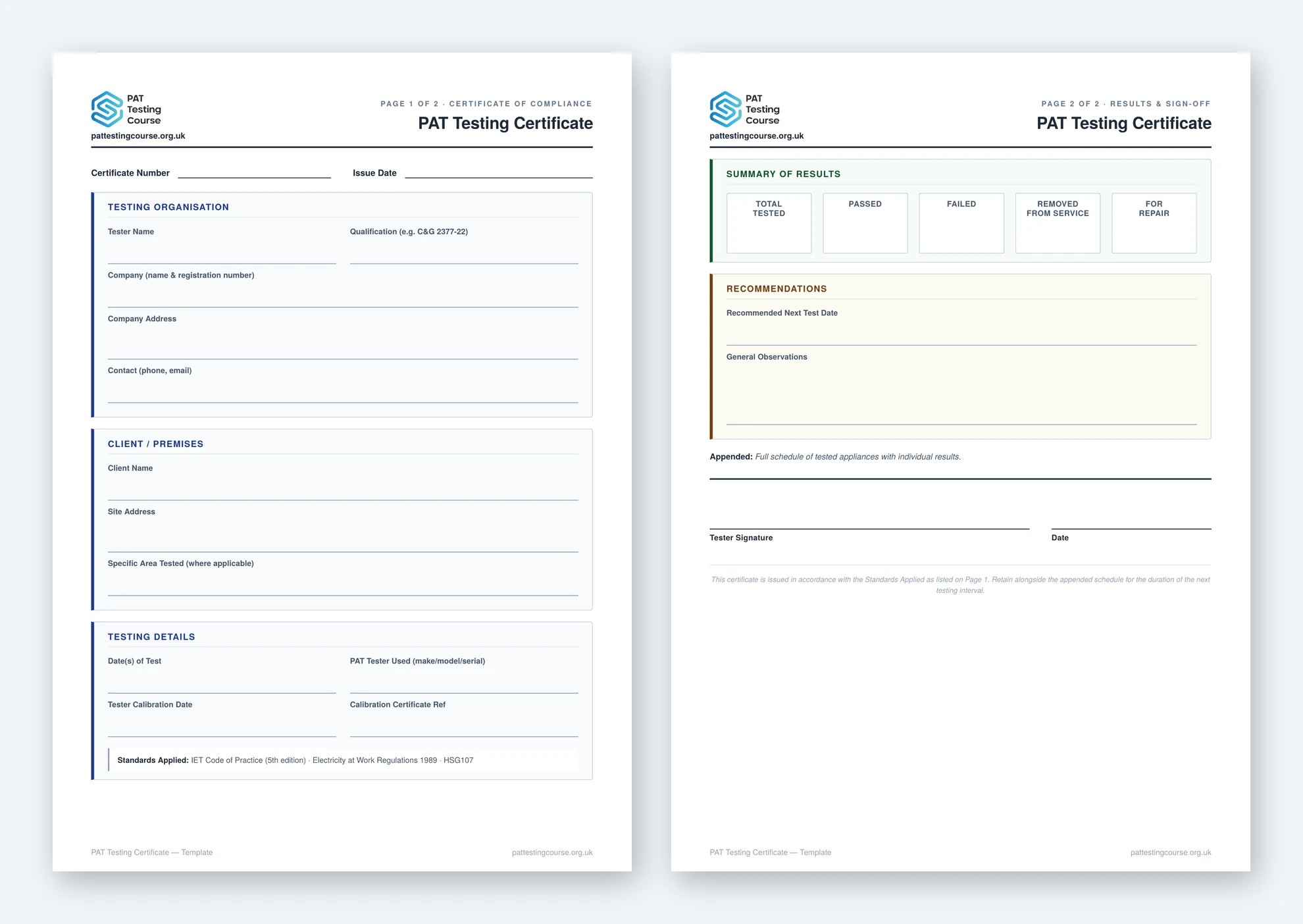
A complete PAT testing certificate should include all of the following:
Tester identification
- Name of the person who carried out the tests
- Their qualifications
- Company name (if testing as a business)
- Contact details
Premises identification
- Full address of the premises tested
- Specific area within larger premises (where applicable — e.g. "Office wing, ground floor")
- Client name and contact
Date of testing
- The actual date(s) the testing was carried out
- Where testing spans multiple days, the date range
Tester equipment details
- Make and model of PAT tester used
- Serial number
- Date of last calibration of the tester
- Calibration certificate reference number
The calibration detail is critical — testing carried out with an out-of-calibration tester can be challenged, and the certificate without calibration evidence is incomplete.
Standards applied
- Reference to the IET Code of Practice (5th edition currently)
- Reference to the Electricity at Work Regulations 1989
- Any specific industry standards applied (e.g. for construction, healthcare)
Summary of results
- Total number of appliances tested
- Number passed
- Number failed
- Number requiring remedial action
List of tested appliances
Either as part of the certificate or as a separate appended schedule:
- Asset/identifier number
- Description (make, model where known)
- Location within premises
- Class (1 or 2)
- Test result (pass/fail)
- Recommended next test date
Failed item details
For any failed items:
- Why they failed (visual defect, electrical test fail, both)
- What action was taken (removed from service, repaired, replaced)
- Whether retesting is required after remediation
Recommendations
- Suggested next test date for the property as a whole
- Any general observations or recommendations
- Items requiring more frequent testing
Tester signature and date
- Physical or digital signature of the tester
- Date of certificate issue (which may differ from the test date)
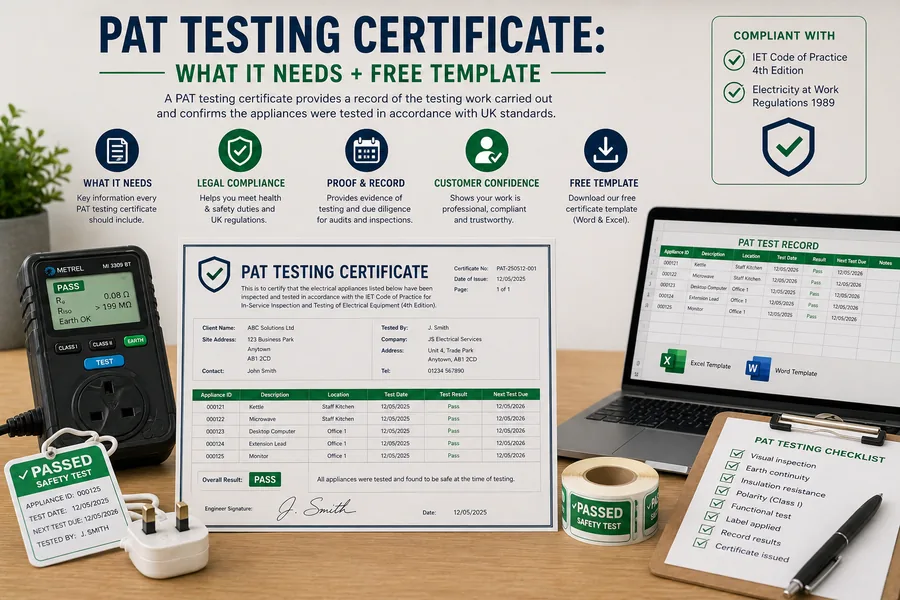
Sample PAT testing certificate template
You can download this certificate template here.
What about individual appliance labels?
Each tested appliance also gets a small label or sticker. These should show:
- The pass/fail status (usually colour-coded: green pass, red fail)
- The test date
- The next test date (where appropriate)
- The tester's identifier (name, initials or ID number)
- The asset number (where used)
Individual labels are NOT certificates in themselves — they're a quick visual indicator. The actual record of the test is the certificate plus the asset register.
Common formats for PAT testing certificates
Single-page summary certificate with appended schedule
The most common format. The certificate is a one-page summary with all the high-level details, and the full appliance list is appended as a separate document (often spreadsheet-formatted).
Software-generated comprehensive report
Many PAT testing software packages generate full reports automatically — typically 5-20 pages depending on appliance count. These integrate the certificate, schedule and any failure details into one document.
Digital/electronic certificates
Increasingly common. The certificate is delivered as PDF (often digitally signed) and stored in cloud-based asset management systems. Same content, paperless format.
All three are equally valid provided the required information is present.
How long is a PAT testing certificate valid?
Strictly speaking, certificates don't "expire" — they're a record of a test on a specific date. What matters is whether the test itself is still within the recommended retest interval.
If a Class 1 office appliance has a 48-month retest interval and was tested 24 months ago, the certificate is still "valid" for compliance purposes. At month 49, the test is out of date and a new certificate is needed — but the original certificate doesn't become invalid retroactively. It just becomes historical evidence.
For specific intervals by environment and appliance type, see our PAT testing frequency post.
How long should you keep certificates?
Recommended retention periods:
- Current certificate: throughout the validity period (until the next test)
- Historical certificates: at least 6 years (the standard limitation period for civil claims in England and Wales)
- For HMOs and licensed properties: throughout the licence period plus any required additional retention
- For commercial premises: through any tenancy plus 6 years
In practice, electronic storage with cloud backup makes indefinite retention painless and is the recommended approach.
Common certificate problems
Missing calibration details
The most common omission. A certificate without calibration evidence is incomplete and can be challenged. Always include the tester's calibration date and certificate reference.
Vague premises descriptions
"Office building" isn't enough. The certificate should identify exactly which premises (full address) and ideally which area within if larger premises are tested in sections.
Missing tester qualifications
Even where the tester is competent, the certificate should record their qualification. Don't just write "PAT tester" — record the specific accreditation (e.g. "City & Guilds 2377-22").
Inadequate failure details
If items failed, the certificate should record what action was taken. "Failed: 3 items" without further detail is insufficient. Specify what failed, why, and what happened to it.
Missing signature
Digital or physical, the certificate needs a tester signature. Unsigned certificates can be questioned.
Who should sign the certificate?
The competent person who carried out the testing — not their manager, employer or anyone else not personally involved. If multiple testers worked on the same job, either:
- One tester signs as the primary responsible person, or
- Multiple testers each sign with the items they personally tested
Don't have a third party sign on behalf of the tester unless they were also involved in the testing.
Templates and software
For occasional in-house testing, the simple template above is fine — fill it in manually after each testing round. For regular professional testing, software solutions (PATGuard, SimplyPats, manufacturer-specific options) automate certificate generation entirely.
The middle ground for most landlords and small businesses: a customised spreadsheet template that pulls together the certificate and appliance schedule. Our record sheet template post has a free downloadable template that pairs with the certificate format above.
Frequently asked questions
Is a PAT testing certificate legally required?
Not specifically by name, but the underlying records of testing are required by PUWER 1998. In practice, certificates are universally expected because they're the cleanest format for those records.
How long does a PAT testing certificate last?
The certificate doesn't formally expire — it's a record of a test on a specific date. The test itself remains "current" for the recommended retest interval, which varies by appliance and environment.
Can I write my own PAT testing certificate?
Yes — there's no required template or accrediting body. The certificate must contain accurate information about the testing carried out, but the format is up to you. Use the template structure above as a starting point.
Do PAT testing certificates need to be signed?
Yes — by the competent person who carried out the testing. Digital signatures are acceptable. Unsigned certificates can be questioned in any compliance review.
Can I get a PAT testing certificate without being a qualified electrician?
Yes. PAT testing requires a competent person, not a qualified electrician. The certificate is issued by whoever does the testing, and their qualification (typically City & Guilds 2377-22 or equivalent) is recorded on the certificate.
What if I lose my PAT testing certificate?
Contact the tester or testing company — they should retain copies and can issue replacements. If the original tester is unavailable, the safest answer is to repeat the testing and issue a new certificate.
Are digital PAT testing certificates valid?
Yes. PDF certificates with digital signatures are widely accepted by insurers, councils and inspectors. Cloud-stored certificates with proper audit trails are equivalent to paper.
The takeaway
A valid PAT testing certificate isn't complicated — it just needs the tester's identification and qualification, the premises tested, the date of testing, the calibration status of the tester used, the standards applied, the results summary and details of any failures.
For occasional in-house testing, a simple template like the one above does the job. For regular professional testing, software handles the formatting automatically. Either way, the content matters far more than the design — get the required fields right and the document does its job.
If you're testing your own properties or business and want to issue your own certificates with proper authority, an accredited PAT testing course gives you both the competency to test and the qualification to record on the certificate. For most users, that's the cleanest route to certificates that stand up to any inspection.