
%201.svg)


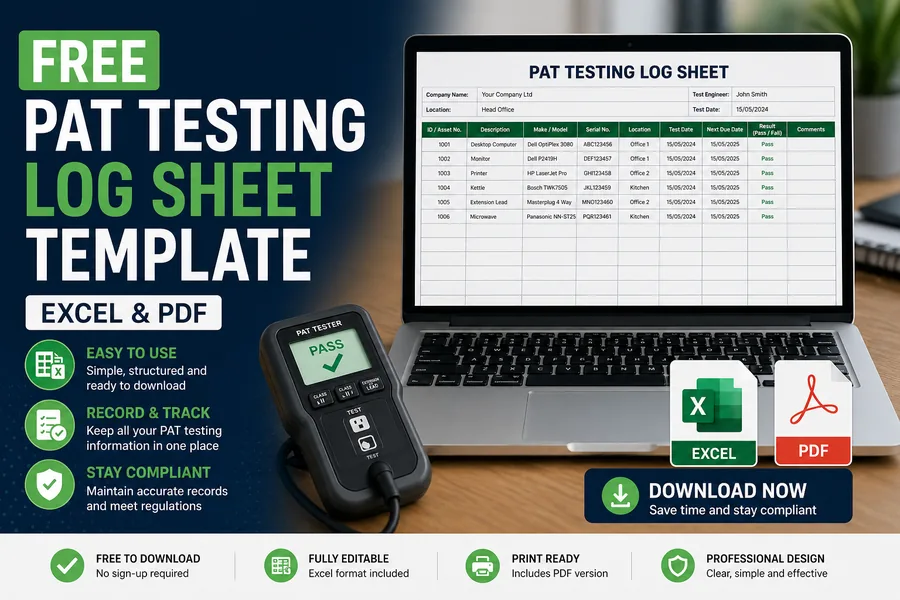
Every PAT testing regime needs a record sheet — a running log of every appliance, every test, and every result. Without one, you've got individual certificates that don't tell you what to test next, when, or where the gaps are.
This post covers what a proper PAT testing log sheet should contain, how long records need to be kept, and gives you a ready-to-use template structure you can recreate in Excel, Google Sheets, or any spreadsheet tool.
Why a record sheet matters
Individual PAT testing certificates record what happened during one specific testing session. A record sheet tracks the full history of every appliance over time — every test, every result, every change-out, every move between locations.
The two work together:
- Certificate: snapshot of one testing session
- Record sheet: running history of every appliance
The record sheet is what tells you, in March 2027, whether the kettle in Office 3 was last tested in October 2025 and is due again. The certificate just tells you what happened in October 2025 in isolation.
For most premises, the record sheet is also what HSE inspectors, licensing officers and insurers will ask to see alongside (or sometimes instead of) certificates. A good record sheet is the single most useful document in any PAT testing regime.
What a complete record sheet should contain
For each appliance:
Identification fields
- Asset/ID number: a unique identifier you assign (e.g. ASR-001, KIT-K001, etc.)
- Description: type of appliance (kettle, microwave, desk lamp)
- Make and model: where known
- Serial number: where readable
- Class: 1 or 2
Location fields
- Site/premises: which property
- Room or area: specific location within the premises
- Department or assigned user: where applicable
Status fields
- In service date: when the appliance was first added to the register
- Status: in service / removed / disposed / under repair
Test history fields (one row per test)
- Test date
- Test result (pass/fail)
- Tester name (and qualification reference)
- Detailed readings if relevant (earth continuity in ohms, insulation resistance in megohms)
- Any notes: visual issues spotted, action taken, anything unusual
- Next test date
Failure tracking
- If failed: reason, action taken, replacement details, date of remediation
- Retest date (where applicable)
A working record sheet structure (<50 items)
Download the small version (<50 items):
Here's a column structure that works for most premises in Excel or Google Sheets:
For larger registers, separate sheets for each property or each test session work well. For smaller registers (<50 items), a single sheet with all history captured in additional columns or a separate "test log" sheet is fine.
A working record sheet structure (>50 items)
Download the large version (>50 items):
Sheet 1: Asset Register
Sheet 2: Test History Log
Sheet 3: Failed Items Log
For tracking every failure and remediation:
This three-sheet structure scales from small landlord portfolios up to multi-site businesses with thousands of appliances.
Whether to use Excel/Sheets or dedicated software
Spreadsheets work well when:
- You have under 200 appliances total
- You're testing infrequently (annually or less)
- You're handling one or a few sites
- You're comfortable with spreadsheet formulas
- Your team uses spreadsheets day-to-day anyway
Dedicated software works better when:
- You have 200+ appliances
- Multiple sites or premises
- Testing is a regular professional activity
- You want automatic retest reminders
- You need integration with PAT testers (auto-import of results)
- You need barcode scanning workflows
The middle ground: cloud-based property management systems (Arthur, RentMan, Goodlord for landlords; PATGuard, SimplyPats for testers) handle PAT testing records natively alongside other property records.
For occasional in-house users, a well-structured spreadsheet is genuinely fine and avoids the cost and lock-in of paid software.
Retention: how long to keep records
Recommended retention periods:
Live records (in active use)
- Current test record: throughout the testing interval
- Most recent failed item records: throughout remediation period
Historical records
- Standard businesses: minimum 6 years (English/Welsh civil claim limitation period)
- Scotland: minimum 5 years (Scottish prescription period)
- HMOs and licensed properties: throughout the licence period + 6 years
- Healthcare and high-risk environments: longer retention often required by sector-specific rules
- Insurance: check policy wording — some require 7+ year retention
In practice, electronic storage makes indefinite retention painless. Cloud-based systems with proper backup mean retention costs are minimal — there's no good reason to delete historical records once electronic.
Where records typically fail
Inconsistent asset IDs
Each appliance needs a stable, unique identifier. The most common error is informally using descriptions instead of IDs ("the kettle in the kitchen"), which works until two kitchens have kettles or the kitchen kettle is replaced.
Adopt a clear ID convention and stick to it: site code + appliance type + sequential number is a robust pattern (e.g. OFC-K001 for "Office, Kettle, Item 001").
Lost between testers
When PAT testing is outsourced, contractors typically use their own asset IDs and records. If you change contractors, the asset history can be effectively lost. Always:
- Keep your own records, parallel to the contractor's
- Use your own asset IDs (don't rely on the contractor's)
- Get a copy of all detailed records on each test, not just the certificate
Untracked appliance changes
When an appliance is replaced (kettle dies, new one bought), the asset ID typically dies with it. The new kettle needs a new asset ID and a fresh entry on the register. Retiring the old asset cleanly avoids confusion later.
Forgotten when premises change hands
When buildings change occupants — landlord sells the property, business moves office — the PAT testing records often get lost. Best practice: hand over records explicitly as part of the transaction, and retain copies for the limitation period.
Records not kept beyond compliance period
Some businesses bin records as soon as the appliance is replaced or the testing interval is up. This leaves no defence if a historical issue emerges later (e.g. an old equipment fault traced back two years). Retain everything for at least 6 years.
Specific record sheet variations
Landlord and HMO record sheets
Often organised by property first, then by appliance within property. For multi-property portfolios, a master sheet linking individual property records is useful.
Construction site record sheets
Need to handle higher volumes of testing (3-month intervals on handheld tools), often with rapid asset turnover. Software is usually justified at this scale.
School record sheets
Often broken down by department (Science, D&T, Music, etc.) because each department's equipment has different testing patterns and inventory ownership.
Holiday let record sheets
Typically combined with the property's wider compliance documentation (gas safety, EICR, fire risk assessment) into a single property compliance file.
Frequently asked questions
Is a PAT testing log sheet legally required?
Records are required by PUWER 1998 where appropriate. The format isn't specified — a log sheet, asset register, or software output all qualify. The information matters, not the format.
How do I keep a PAT testing record?
Maintain a register of every appliance with its identification, location, class and full test history. For most users, a structured spreadsheet works fine. Larger operations benefit from dedicated software.
How long should PAT testing records be kept?
Minimum 6 years in England and Wales (the limitation period for civil claims), 5 years in Scotland. For HMOs and licensed properties, retain throughout the licence period plus the limitation period. Indefinite electronic retention is the practical answer.
Can I just keep the PAT testing certificate without a log sheet?
You can, but you'll find it impractical quickly. Certificates record one testing session — they don't tell you what's due next, where it is, or what its history was. The log sheet is what gives you ongoing operational visibility.
Do PAT testing records need to be on paper?
No. Electronic records (spreadsheets, software, cloud-based systems) are entirely acceptable provided they're complete, accurate, accessible and properly backed up.
What's the difference between a record sheet and an asset register?
In practice they're the same thing. "Asset register" emphasises the inventory aspect (what appliances you have); "record sheet" or "log sheet" emphasises the testing history. A complete record sheet does both.
The takeaway
Build a structured record sheet from day one. The three-sheet structure above (asset register, test history, failed items) handles everything from a single landlord property up to a multi-site business with thousands of appliances. For most users, a spreadsheet does the job; software is only needed at scale.
Keep records electronically, back them up, and retain everything for at least 6 years. The record sheet is the document that makes your testing regime operationally useful — without it, you've got individual tests with no system around them.
If you're starting your in-house testing journey, an accredited PAT testing course covers documentation requirements alongside the practical testing skills, so the record-keeping is built into your workflow from the start rather than bolted on afterwards.