
%201.svg)


PAT testing and EICR are two of the most common electrical safety inspections in the UK — and they're regularly confused, conflated or assumed to overlap. They don't. They test fundamentally different things, are required at different intervals, and need different qualifications to carry out.
This post explains exactly what each one is, where the line between them sits, and when you need one, the other, or both.
The one-sentence summary
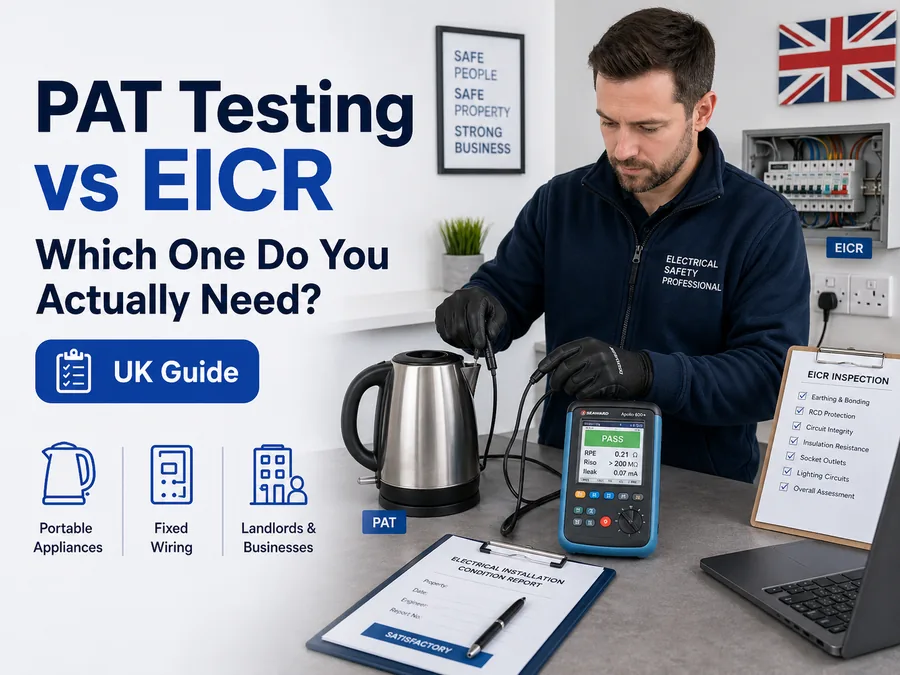
PAT testing checks individual appliances that plug in. An EICR checks the building's fixed electrical wiring.
Everything else is detail.
What PAT testing actually checks
PAT testing — Portable Appliance Testing — examines plug-in electrical appliances:
- Kettles, microwaves, toasters
- PCs, laptops chargers, monitors, printers
- Vacuum cleaners, fans, lamps
- Power tools and workshop equipment
- Extension leads and IEC leads
- Fridges, freezers, dishwashers
- Anything else with a plug
The test combines a visual inspection with electrical tests:
- Earth continuity (Class 1 appliances)
- Insulation resistance
- Polarity check
- Functional check
For a complete breakdown of how PAT testing works, see our main PAT testing guide.
What an EICR actually checks
An EICR — Electrical Installation Condition Report — examines the fixed electrical installation of a building:
- The wiring throughout the building
- The consumer unit (fuse box) and protective devices
- Sockets and switches (the fixed bits, not what's plugged into them)
- Lighting circuits (the fixed wiring, not the lamps)
- Earth bonding and earthing systems
- Fixed appliances connected directly into the wiring
The EICR is carried out by a qualified electrician (typically City & Guilds 2391 or equivalent) using specialist test equipment that examines circuits rather than appliances.
The output is a comprehensive report classifying the installation:
- C1 (Code 1) — Danger present. Immediate remedial work required.
- C2 (Code 2) — Potentially dangerous. Remedial work required.
- C3 (Code 3) — Improvement recommended (but not unsafe).
- FI (Further Investigation) — Issue identified that needs more detailed examination.
A "satisfactory" EICR has no C1 or C2 findings.
The key practical differences
| Feature | PAT Testing | EICR |
|---|---|---|
| What's tested | Plug-in appliances | Fixed wiring and installation |
| Who tests | Competent person (PAT-qualified) | Qualified electrician |
| Equipment used | PAT tester | Multi-function installation tester |
| Typical frequency | 1-5 years (varies by environment) | Every 5 years (residential), 5 years or change of occupancy (commercial) |
| Output | Individual appliance certificates + register | Comprehensive installation condition report |
| Typical cost | £50-300 per visit | £150-£500 per inspection |
| Typical duration | 1-4 hours | 2-6 hours for typical premises |
| Disruption | Minimal | Significant — circuits switched off during testing |
Where the boundary actually sits
The line between PAT testing and EICR scope:
PAT testing covers:
- Anything that plugs into a socket
- IEC leads and detachable leads
- Some "fixed" appliances that are connected via a fused spur (hand dryers, wall heaters)
EICR covers:
- The wiring carrying electricity through the building
- Sockets and switch fittings (the building-side electrical hardware)
- Consumer unit and circuit breakers
- Earthing system
- Hard-wired fixed appliances (where they're directly wired in, not via a fused spur)
The grey area: fixed appliances
Some appliances sit on the boundary. A wall-mounted hand dryer, for example:
- The hand dryer itself = PAT test
- The fused spur it's wired into = EICR
- The switch on the spur = EICR
Both inspections are needed; neither covers the other.
When you need PAT testing
For most UK businesses, landlords and public premises:
- Workplace: every 1-5 years depending on environment and appliance class
- Rental properties: typically every 2 years and at change of tenancy
- HMOs: typically annually as a licence condition
- Holiday lets: typically annually
- Schools: typically annually for handheld equipment, 4-yearly for IT/stationary
- Construction sites: every 3 months for handheld tools
For a complete frequency breakdown, see our PAT testing frequency post.
When you need an EICR
EICR requirements depend on premises type:
Residential rentals (England)
The Electrical Safety Standards in the Private Rented Sector (England) Regulations 2020 require:
- An EICR every 5 years
- An EICR at change of occupancy (if older than the standard interval)
- A "satisfactory" rating (no C1 or C2 findings) before letting
Failure to comply can result in civil penalties up to £30,000 and prevent the property being let.
Wales, Scotland and Northern Ireland
Each has similar requirements with minor variations. Scotland has had EICR requirements since 2015; Wales and Northern Ireland have parallel regimes.
HMOs (UK-wide)
EICR is typically a licence condition, often required every 5 years.
Holiday lets
Most holiday let insurers and tourism quality schemes require EICR every 5 years; Scottish licensing requires it as a condition.
Commercial premises
Strictly, no specific EICR requirement under the regulations — but the Electricity at Work Regulations 1989 require fixed installations to be safe, and EICR is the recognised method of demonstrating that. Most commercial premises EICR every 5 years; some industries (healthcare, education) more often.
Sale of property
Increasingly, EICR is requested as part of property due diligence at sale. Mortgage lenders and conveyancers may flag absence as a concern.
When you need both
For most premises, both PAT testing and EICR are needed:
- Rental property: EICR every 5 years + PAT testing of supplied appliances every 2 years
- Office: EICR every 5 years + PAT testing on standard cycles for appliances
- Holiday let: EICR every 5 years + annual PAT testing
- HMO: EICR every 5 years + annual PAT testing
- School: EICR every 5 years + annual PAT testing for relevant categories
The two inspections complement each other — neither is a substitute for the other, and no single inspection covers what both together do.
Common confusions
"Did the EICR cover the appliances?"
No. The EICR covers the fixed installation. Appliances are separate and need PAT testing.
"Did the PAT testing cover the wiring?"
No. PAT testing covers plug-in appliances. The wiring needs an EICR.
"I had both done last year — am I covered for 5 years?"
The PAT testing isn't valid for 5 years for most appliance types (typical intervals are 1-4 years). The EICR is valid for the full 5 years.
"My contractor did 'a full electrical inspection' — does that include both?"
Possibly, but check what's actually been delivered. Some contractors offer combined PAT + EICR services. Others offer one but not the other. Always confirm.
"My EICR is satisfactory — do I still need PAT testing?"
Yes. Different things. A satisfactory EICR doesn't tell you anything about whether your appliances are safe.
Cost comparison
For typical UK 2026 prices:
PAT testing (per visit):
- Small office (50 items): £75-100
- Medium office (200 items): £200-280
- HMO (40 items): £60-100
- Holiday cottage (60 items): £80-120
- School (3,000 items): £2,500-4,000
EICR (per inspection):
- Small flat: £150-200
- 3-bedroom house: £200-300
- HMO: £250-400
- Small office: £250-400
- Larger commercial: £400-£1,000+
Combined annual costs for a typical HMO running both:
- PAT testing (annual): £80-120
- EICR (every 5 years, average per year): £60
- Total annual electrical compliance: ~£140-180
Combined annual costs for a typical office:
- PAT testing (every 2-4 years, average per year): £30-100
- EICR (every 5 years, average per year): £80
- Total annual electrical compliance: ~£110-180
Both are minor costs compared to the consequences of being non-compliant when something goes wrong.
Who carries out each?
PAT testing
A "competent person" — typically demonstrated through:
- City & Guilds 2377-22 (PAT testing qualification)
- EAL Level 3 in PAT Testing
- Equivalent industry qualifications
PAT testers don't need to be qualified electricians. A one-day accredited PAT testing course is the standard route.
EICR
A qualified electrician — typically demonstrated through:
- City & Guilds 2391-50 (Inspection and Testing of Electrical Installations)
- City & Guilds 2391-51 (Initial and Periodic Inspection)
- 18th Edition certification (BS 7671 Wiring Regulations)
- Membership of NICEIC, NAPIT, ECA, Stroma or similar
- Significant on-the-job experience
EICR isn't something a PAT tester can do without significant additional qualifications and experience.
Practical considerations
Should you use the same contractor for both?
Often convenient. Some contractors offer bundled services. Pros: convenience, consistency, possible cost saving. Cons: may not get specialist expertise on either.
Should they be done at the same time?
Possible but disruptive — EICR involves switching off circuits, which interrupts PAT testing of equipment running on those circuits. Typically scheduled separately.
What documents should you keep?
For each:
- Recent PAT testing certificate(s) and asset register
- Most recent EICR with all attachments
- Records of any remedial work completed
- For HMOs and licensed properties: proof submitted at licence renewal
Retain electronically with backups. Retain for at least 6 years after the inspection (or longer if in-tenure, in-licence, or otherwise legally relevant).
Frequently asked questions
What's the difference between PAT testing and EICR?
PAT testing checks individual plug-in appliances (kettles, PCs, microwaves). EICR checks the building's fixed electrical wiring (sockets, switches, consumer unit, circuits). They test different things and aren't interchangeable.
Do landlords need both PAT testing and EICR?
Yes, for most rental properties. EICR every 5 years is legally required in England, Scotland and Wales. PAT testing of supplied appliances is the standard way to meet the duty to ensure those appliances are safe.
Can a PAT tester do an EICR?
Generally no. EICR requires qualified electrician credentials (City & Guilds 2391, 18th Edition, etc.). PAT testing requires competence (City & Guilds 2377-22 typically) but not full electrician qualification.
Is an EICR a legal requirement for businesses?
Not by name in any specific regulation, but the Electricity at Work Regulations 1989 require fixed installations to be safe, and EICR is the standard accepted way of demonstrating that. Most commercial premises EICR every 5 years.
How long does an EICR last?
5 years for residential rental properties (statutory). 5 years for most other settings as the recognised standard. Specific high-risk environments may require more frequent testing.
Can the EICR identify problems with appliances?
Generally no. The EICR examines the fixed installation, including the protective devices (RCDs, MCBs) that would respond to appliance faults — but doesn't examine individual appliances themselves.
What happens if I have an EICR with C1 or C2 findings?
C1 findings require immediate action (typically isolating the circuit until remedial work is done). C2 findings require remedial work to make the installation satisfactory. Neither is the end of the world, but both need addressing — and rental properties with C1/C2 findings can't be legally let until remedied.
The takeaway
PAT testing and EICR aren't the same thing and don't substitute for each other. PAT testing covers your plug-in appliances and is needed regularly (every 1-5 years depending on environment). EICR covers your fixed electrical installation and is needed every 5 years for most premises.
For most UK businesses, landlords and premises managers, both are required as part of the standard electrical safety regime. Plan for both, schedule them at appropriate intervals, and keep proper records of each.
If you're handling PAT testing yourself, an accredited PAT testing course gets you the competence to deliver that side of the regime. EICR remains the territory of qualified electricians — sensibly so, given the specialist nature of the installation testing.
Get both done, get the records right, and the electrical safety basics are properly handled.