
%201.svg)


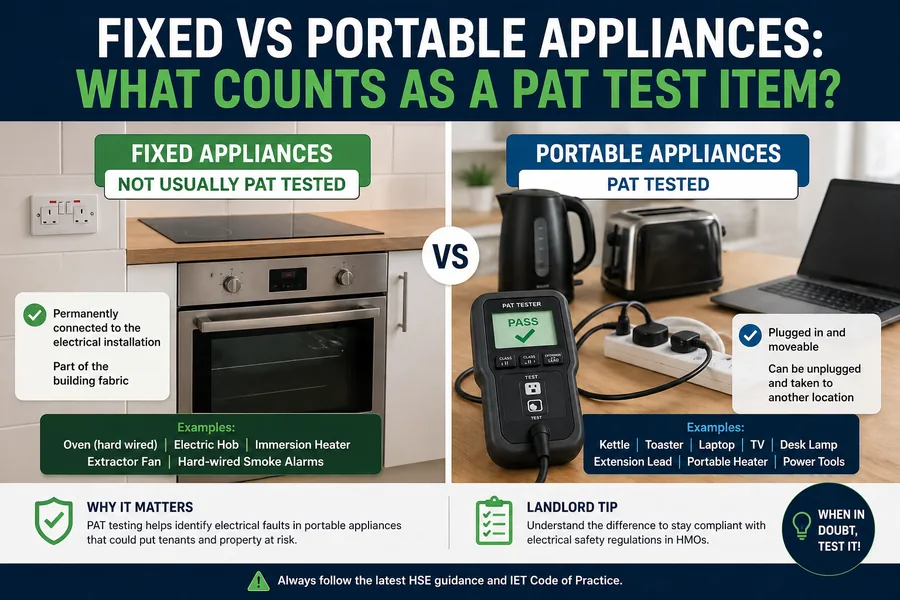
The terms "fixed" and "portable" come up constantly in PAT testing — but they don't mean what most people assume. A fridge weighing 80kg in a permanent corner of a kitchen is, in PAT testing terminology, a "movable" appliance. A wall-mounted heater that hasn't shifted in 20 years is a "fixed" appliance. A 70-pound microwave is "portable."
This guide explains the official PAT testing definitions of fixed, portable, movable, stationary and handheld equipment — and crucially, why the distinctions matter for what gets tested and how.
Why the categories exist
The IET Code of Practice for In-service Inspection and Testing of Electrical Equipment splits appliances into a series of categories based on how the appliance is intended to be used and moved. The categories matter because:
- Testing intervals differ. Handheld appliances get tested most often (they're moved, knocked and dropped); fixed appliances least often (they don't move).
- Test procedures differ. Plug-in appliances are tested via the plug; fixed appliances are tested via separate leads.
- Some categories aren't tested at all under standard PAT testing — they fall under EICR or other inspection regimes.
Getting the category right is the foundation of building a proper testing schedule.
The five appliance categories
Handheld appliances
Definition: equipment intended to be held in the hand during normal use.
Examples: drills, hairdryers, kettles, irons, soldering irons, electric carving knives, hot glue guns.
Why they matter: they're constantly being held, moved and put down, so cables and casings see the worst wear of any appliance category. They have the tightest testing intervals.
Portable appliances
Definition: equipment less than 18kg, intended to be easily moved from one place to another while in use or between uses.
Examples: small microwaves, table lamps, desk fans, toasters, small radios, table-top mixers.
Why they matter: they get moved regularly but aren't held in the hand — slightly less wear than handheld but still relatively high. Standard portable testing intervals apply.
Movable appliances
Definition: equipment less than 18kg or fitted with wheels/castors, intended to be moved when not in operation.
Examples: small office fridges, desktop PCs, larger desk fans, portable air conditioners, hostess trolleys.
Why they matter: they don't move during use but get pushed/lifted occasionally — fewer cable stress events than portable appliances. Slightly longer testing intervals.
Stationary appliances
Definition: equipment over 18kg that's not normally moved during use.
Examples: large commercial fridges, full-size washing machines, photocopiers, large printers, commercial cookers (free-standing).
Why they matter: minimal cable wear from movement, so longer testing intervals. The testing procedure is the same as portable (plug-based) but the frequency is reduced.
Fixed appliances
Definition: equipment fastened to a support, location or building, typically hard-wired or with restricted-access connection points.
Examples: wall-mounted hand dryers, fixed extractor fans, water heaters, wall-mounted fan heaters, immersion heaters, fixed industrial machinery.
Why they matter: they don't move at all, so cable wear is essentially zero. They get the longest testing intervals. The testing procedure is also different — see below.
The fixed/non-fixed distinction matters most
Of all the category boundaries, the line between fixed appliances and everything else is the most important — and the most commonly misunderstood. The other categories share a testing approach (plug into the tester, run the standard sequence) and just differ on frequency. Fixed appliances are tested differently.
How fixed appliances are tested
Because fixed appliances aren't plugged in, they can't be tested via the tester's mains socket. Instead, the procedure is:
- Isolate the appliance from its supply (turn off the relevant fuse or breaker)
- Confirm dead with a voltage tester
- Connect the PAT tester's leads directly to the appliance's terminals
- Run earth continuity between earth conductor and appliance casing
- Run insulation resistance between live/neutral conductors and earth, with the appliance's switch in the "on" position
Reconnect, restore supply, functional check
This is more involved than plug-in testing and requires the tester to safely isolate and reconnect mains wiring. For commercial premises with multiple fixed appliances, fixed-appliance testing is often combined with the EICR inspection of the fixed installation rather than handled as part of standard PAT testing rounds.
Why the distinction matters for record-keeping
A common mistake is including fixed appliances in the standard PAT testing register without flagging them differently. This causes problems because:
- The standard frequency for "stationary" equipment may be applied where "fixed" was meant
- The next testing date assumes plug-in testing rather than terminal-level testing
- Contractors quoted to test "X items" may not realise some require isolation
Best practice is to maintain fixed appliances as a clearly separated category on the asset register, with their own testing schedule and tester competency requirements.
Where 3-phase equipment fits in
Three-phase equipment (running on a 415V industrial supply rather than 230V single-phase) is its own subset. It can be portable, stationary or fixed depending on how it's installed, but the testing complications add up:
- Three-phase plugs are a different connector type and need a tester capable of handling them
- The test sequence covers earth continuity on each phase conductor, plus insulation resistance between phases
- Many standard PAT testers don't handle 3-phase at all — specialist testers (or industry-specific PAT testers from the higher tiers) are required
- Many testers competent in standard single-phase work aren't experienced with 3-phase
For premises with a mix of single-phase and three-phase equipment — typical in commercial kitchens, light manufacturing and laundries — the practical answer is to either find a tester experienced in both, or to handle 3-phase testing as a separate engagement (often via the electrical contractor doing the EICR).
Edge cases and grey areas
Some appliances don't sit neatly in any one category. The standard approach:
Castor-mounted equipment
A 50kg trolley-mounted appliance is technically "movable" (over 18kg but with wheels), but castor-mounting often allows the appliance to be moved during use, which suggests "portable" treatment. Use the more conservative (more frequent) testing interval.
Plug-in equipment in a fixed location
A photocopier that's been in the same corner for ten years and weighs 200kg is "stationary" — not fixed — because it's still plug-connected. The testing procedure is plug-based, just with the longer stationary interval.
Hard-wired equipment that could in principle be relocated
A hand dryer is "fixed" because it's bolted to the wall and hard-wired through a fused spur. The fact that someone could in theory move it to another wall doesn't change its category.
Dual-purpose equipment
Some equipment is sold as either portable or fixed depending on installation choice — wall-mountable fan heaters, for example. Categorise based on how it's actually installed in your premises, not on the manufacturer's options.
Battery-charged "portable" equipment
A cordless tool is, technically, a battery-powered device with a separate mains charger. The tool itself isn't tested; the charger is — and the charger's category depends on its own physical characteristics (usually portable).
Why this affects testing frequency
Putting it all together, here's how the categories drive frequency in a typical office or commercial environment:
CategoryClass 1 intervalClass 2 intervalHandheld24 months48 monthsPortable24 months48 monthsMovable48 months48 monthsStationary48 months60 monthsFixed48 months60 months
For other environments (construction, industrial, schools, public-facing) the intervals shift but the relative pattern holds: handheld and portable get tested most often, fixed and stationary least often. Our PAT testing frequency post has the full table per environment.
The interval differences aren't trivial. Treating a stationary fridge as "portable" doubles its testing frequency without adding any meaningful safety benefit. Treating a fixed wall heater as "stationary" reduces interval but also misses that it should be tested via different procedures. Categorising correctly is what turns PAT testing from a standardised rota into a properly risk-based regime.
Frequently asked questions
What is the difference between fixed and portable appliances?
A fixed appliance is fastened to a building or support and typically hard-wired (e.g. wall-mounted hand dryer). A portable appliance is under 18kg, plug-connected, and intended to be moved easily between uses. The testing procedures differ — fixed appliances are tested via their terminals, portable ones via the plug.
What counts as a portable appliance?
In PAT testing terms, a portable appliance is under 18kg, plug-connected, and intended to be moved easily. Examples include small microwaves, desk fans, table lamps, toasters and small radios. Larger plug-connected items become "stationary" rather than portable.
Are fixed appliances exempt from PAT testing?
No. Fixed appliances are still tested, but the procedure is different — the tester connects directly to the appliance's terminals after isolation, rather than via a plug. The testing intervals are typically longer than for movable equipment.
Do hand dryers need PAT testing?
Yes. Hand dryers are Class 1 fixed appliances and need periodic earth continuity and insulation resistance testing. The procedure requires isolating the supply and connecting the tester to the dryer's terminals directly.
Can a single PAT tester handle 3-phase equipment?
Only if it's specifically designed to. Most standard PAT testers handle single-phase 230V (and sometimes 110V) equipment only. Three-phase testing requires either a specialist 3-phase PAT tester or specialist multifunction test equipment.
What's the difference between a stationary and a fixed appliance?
A stationary appliance is plug-connected but rarely moved (e.g. a 200kg photocopier). A fixed appliance is hard-wired or otherwise permanently connected to the supply (e.g. a wall-mounted heater on a fused spur). The plug vs hard-wired distinction is the test.
The takeaway
Get the categories right. Handheld and portable appliances see the most wear and need the most frequent testing; movable, stationary and fixed appliances see less wear and get longer intervals. Fixed appliances are a separate testing procedure entirely and benefit from being tracked as a distinct group.
For premises with a mix of categories — particularly any that include 3-phase equipment or significant fixed-appliance counts — having an in-house tester who understands the distinctions saves a lot of back-and-forth with contractors. A one-day PAT testing course covers all the categories, when to apply each, and the test procedures appropriate to each one.
Categorise correctly, schedule on a per-category basis, and the testing regime stays sensible and proportionate. That's all there is to it.