
%201.svg)


Extension leads are one of the most common categories of equipment in any UK workplace, rental property or commercial premises — and they're also one of the highest-risk for failure. Constantly moved, frequently overloaded, regularly stood on, and often used in ways the manufacturer never intended, extension leads fail more often than most other types of testable equipment.
This post covers exactly why extension leads need PAT testing, how the testing differs from standard appliances, what to look for during inspection, and the specific failure modes that catch out testers and managers alike.
The simple answer
Yes, extension leads need PAT testing whenever the testing applies to other appliances on the premises:
- In workplaces: yes, on the appropriate testing interval
- In rentals and HMOs: yes, where supplied by the landlord
- In holiday lets: yes, annually
- In schools: yes, at the appropriate frequency
- In construction sites: yes, every 3 months for handheld-environment use
Extension leads aren't exempt. They're standard PAT test items.
Why extension leads are higher-risk than most appliances
Several factors combine to make extension leads more failure-prone than other tested items:
Constant movement
Most appliances stay roughly where they're put. Extension leads get unrolled, repositioned, gathered up and rolled out again. This constant manipulation stresses cables and connections.
Cable damage from being stood on or run over
Extension leads cross open floor space. They get walked on. Chair wheels run over them. Doors close on them. Cleaning equipment crosses them.
Overloading
Multi-way extension leads are routinely overloaded with too many appliances at too high a combined wattage. The lead's own internal heating accelerates insulation breakdown.
Daisy-chaining
Extension leads plugged into other extension leads (against the regulations, but common) compound problems — voltage drop, cumulative resistance, increased fault risk.
Cable yanking
Extension leads are frequently disconnected by pulling the cable rather than the plug. Strain relief eventually fails; internal connections work loose.
Outdoor use of indoor leads
Indoor-rated extension leads brought outdoors for occasional use. Moisture ingress, UV degradation, physical damage all accelerate.
The combined effect: extension leads have failure rates 2-3x higher than typical office equipment in identical environments.
Types of extension leads tested
Extension leads come in various types, all needing testing:
Single-socket extension leads
Simple cable with a plug at one end and a single socket at the other. Often used as "trailing leads" to extend reach.
Multi-way extension leads (4-way, 6-way bars)
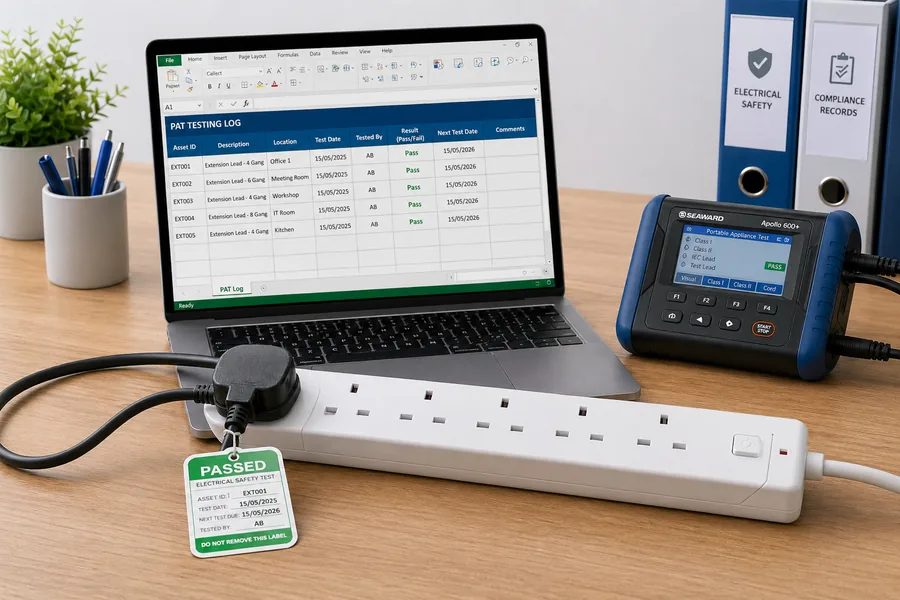
The most common type. A plug, a length of cable, and a bar with multiple sockets. The whole assembly is tested as one unit.
Reel-type extension leads
Cable wound onto a drum, often with built-in thermal cutout. Specific to certain applications. Tested as one unit, with attention to the reel mechanism's operation.
Multi-way adapters (block adapters)
Adapters that plug into a single socket and provide multiple outlets without a separate cable. Tested as one unit.
IEC kettle leads (also called "C13 leads")
The detachable lead between a wall socket and an IEC-input appliance (PCs, monitors, kettles, projectors). Strictly speaking, these are tested separately from their host appliance — they're treated as their own test item.
Travel adapters in commercial use
Adapters allowing UK plugs to fit foreign sockets, or vice versa. In domestic use these typically don't get tested. In commercial/business travel use, they should be.
How extension leads are tested differently from standard appliances
Extension lead testing has specific procedures because the cable runs the length of the lead (often several metres) and contains multiple test points (plug + each socket).
Test sequence
- Visual inspection — same as any appliance, with extra attention to cable damage and socket integrity
- Earth continuity tests: from the plug earth pin to each socket's earth contact. Pass threshold: less than 0.1Ω + cable resistance, typically below 0.5Ω total
- Live continuity tests: from the plug live pin to each socket's live contact. Same threshold approach
- Neutral continuity tests: from the plug neutral pin to each socket's neutral contact. Same threshold approach
- Polarity check on each socket: confirms each socket is wired the correct way round. Pass: each socket correctly polarised
- Insulation resistance: standard 500V test with all socket switches on (where applicable). Pass threshold: greater than 1.0 MΩ
For multi-way extensions, every socket needs individual continuity and polarity testing. A 6-way bar generates more individual test points than most appliances.
What to inspect visually
The visual inspection on extension leads is critical and warrants more attention than most appliances:
The plug end
- Plug body intact, no cracks
- Pins straight, not damaged or showing signs of overheating
- Pin sleeves on live and neutral
- Cable enters cleanly with intact strain relief
- No exposed copper at plug entry
The cable
- Full length walked through, looking for cuts, abrasions, kinks
- No flat or crushed sections (often indicates damage from being stood on)
- No taped joints (a fail — repair, don't tape)
- No signs of overheating along the length (browning, hardening)
- Cable rating appropriate for the load (3A, 5A or 13A indicated by colour-coded inserts)
The socket end (multi-way bars)
- Bar body intact, no cracks
- All sockets undamaged
- Switch mechanism functioning where applicable
- Indicator lamps working (where present)
- No signs of melting or scorching at socket faces
- Bar mounting feet/clips intact
Reel-type extensions
- Cable not damaged at reel mechanism
- Reel rotates smoothly
- Thermal cutout (where present) functioning
- Cable fully unwound for use (not used while still rolled — overheating risk)
Markings and ratings
- Manufacturer name and model legible
- Maximum load (in amps or watts) clearly marked
- CE/UKCA marking present
Common extension lead failures
Real-world failures that come up regularly:
Damaged earth pin on the plug
Often pushed in or broken off entirely on cheap leads. Polarity and continuity tests on the live and neutral might pass, but earth is compromised. Class 1 appliances using the lead would have no earth — dangerous.
Insulation breakdown along the cable
Long extension leads accumulate damage. Insulation resistance can drop below threshold even when the cable looks superficially fine. Insulation testing catches what visual inspection might miss.
Cracked socket bodies
Multi-way bars dropped or damaged develop hairline cracks that admit moisture or expose live conductors. Visual inspection essential.
Reverse polarity on individual sockets
Cheaper multi-way bars sometimes have one socket wired the wrong way round (manufacturing defect). Polarity check on each socket catches this — testing only one socket would miss the problem.
Failed thermal cutouts in reel-type leads
The thermal cutout protecting against overheating sometimes fails. The lead works normally but lacks the safety mechanism. Specific testing or replacement is needed.
Worn 13A fuses
Inside the plug, the fuse can sometimes look fine but be near end of life. Replacement during testing rounds is good practice for older leads.
Internal wire breakage
Occasional internal cable breaks where the cable enters strain relief. Tests pass briefly when the cable is in one position; fail when bent another way. Catch these by manipulating the cable during continuity tests.
How often should extension leads be tested?
Extension leads typically follow the testing intervals for portable equipment in their environment:
- Construction sites: every 3 months
- Industrial/workshop: every 6-12 months
- Schools: every 12 months
- Public-facing premises: every 12 months
- Standard offices: every 24 months
- Rental properties: every 24 months or at change of tenancy
Many premises test extension leads more frequently than other items because of the higher failure rate. A quarterly visual inspection with annual full testing is a reasonable approach for any environment with significant extension lead use.
For full intervals by environment, see our PAT testing frequency post.
What about daisy-chaining?
Daisy-chaining (extension leads plugged into other extension leads) is bad practice for several reasons:
- Voltage drop accumulates, reducing performance
- Cumulative resistance increases heat generation
- Combined load can exceed individual lead ratings
- Trip hazards multiply
UK regulations don't strictly prohibit daisy-chaining, but most workplace policies and HMO licence conditions do. From a PAT testing perspective:
- Each lead is tested individually
- The combination is not separately certified
- The end-user remains responsible for not exceeding rated loads
Practical advice: don't use daisy-chained extensions. Use a single appropriately-rated lead instead.
Indoor-only vs outdoor-rated leads
Standard indoor extension leads are not designed for outdoor use. Specific outdoor-rated leads (typically with appropriate IP rating, often IP44 or higher) are designed for occasional outdoor use.
In outdoor or wet environments:
- Use leads specifically rated for the environment
- Inspect more frequently for moisture ingress
- Replace promptly when any damage occurs
- Don't use indoor-rated leads outdoors, even briefly
A standard indoor lead used outdoors is failing the manufacturer's specifications and creates risk regardless of testing status.
The PAT testing label
Each tested extension lead gets a label showing:
- Pass/fail status (usually colour-coded green/red)
- Test date
- Next test date
- Tester ID
The label is typically placed near the plug end where it can be inspected easily but not where it interferes with use.
Frequently asked questions
Do extension leads need PAT testing?
Yes — wherever PAT testing applies to other equipment in your premises, extension leads are included. They're not exempt.
How are extension leads tested differently from other appliances?
Each socket gets individual continuity and polarity tests (rather than just one set of tests for the appliance overall). Insulation resistance is tested across the full length.
What's the pass threshold for extension lead earth continuity?
Less than 0.1Ω plus cable resistance — typically below 0.5Ω total. Same threshold as for other Class 1 appliances.
Can a damaged extension lead be repaired?
In some cases yes (replacing a damaged plug, fitting a new fuse). For damaged cable runs, replacement is almost always more practical than repair. Never tape-repair a damaged cable — replace.
Why do extension leads fail testing more often than other items?
Constant movement, stress damage, overloading, environmental exposure, and rough handling combine to cause higher failure rates. The same lead in a workshop will fail more often than in a quiet office.
Should I PAT test the kettle lead from my computer separately?
Yes. The IEC lead between a PC and the wall is tested separately from the PC itself, as a detachable lead.
Are reel-type extension leads tested the same as flat ones?
Mostly yes, but with extra attention to the reel mechanism and (where present) thermal cutout. The reel mechanism can be damaged in ways that aren't immediately obvious.
The takeaway
Extension leads are standard PAT test items, not exempt items. They're also among the highest-failure-rate categories because of how they're used — moved, walked on, overloaded, and stressed in ways most appliances aren't.
The testing procedure is more involved than for standard appliances because each socket needs individual continuity and polarity testing. Visual inspection is particularly important — most extension lead failures are visible if you know what to look for.
For premises with significant extension lead use, more frequent visual checks (quarterly) plus annual full PAT testing is the practical approach. For testers wanting to handle extension lead testing properly, an accredited PAT testing course covers the specific procedures and common failure modes alongside general PAT testing competence.
Test them properly, replace them rather than repairing, and don't daisy-chain. That's the workable extension lead PAT testing approach in full.