
%201.svg)


Every electrical appliance in the UK is built to one of three protection classes — Class 1, Class 2 or Class 3. The class tells you how the appliance protects you from electric shock, and crucially for PAT testing, it tells you what tests the appliance needs.
This post explains the difference between the classes, how to identify which class your appliance is, the symbols to look for, real examples for each class, and how the testing procedures differ.
The basic concept: how appliances protect you
Mains electrical appliances handle 230V — voltages that can easily kill if they reach a person. Every appliance is designed with at least one protection method to prevent that. The protection class describes which method.
- Class 1: protected by an earth connection — if a fault makes the metal casing live, the earth carries the current safely away
- Class 2: protected by double or reinforced insulation — there's no earth, but the insulation alone is strong enough that no fault can make exposed parts live
- Class 3: powered by extra-low voltage (typically 12V or 24V) — even direct contact with live parts isn't dangerous
For PAT testing purposes, the distinction that matters most is between Class 1 (needs earth continuity testing) and Class 2 (doesn't need earth testing, but needs higher insulation testing standards). Class 3 appliances technically don't need PAT testing at all, but the power supply converting mains to low voltage does.
How to tell what class an appliance is
Method 1: Look for the Class 2 symbol
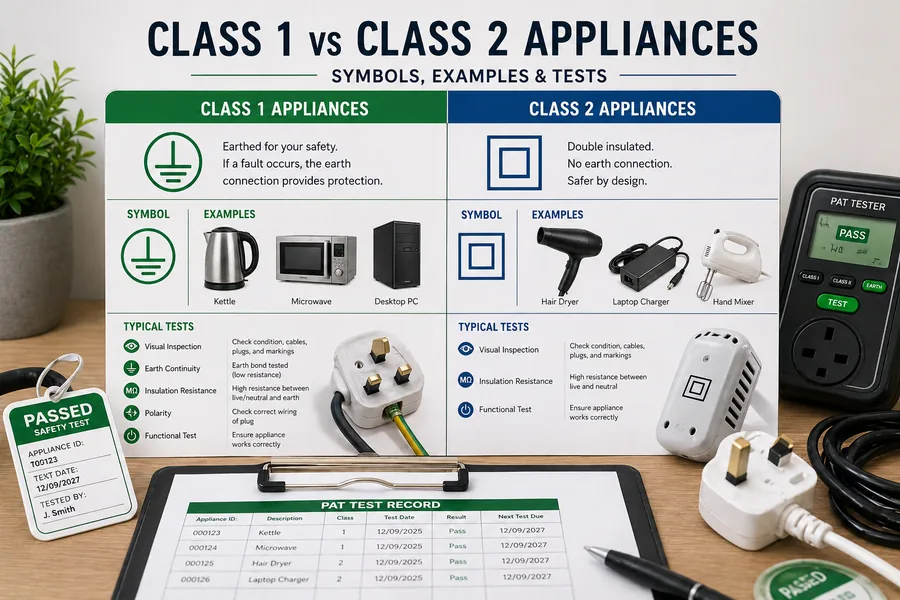
Class 2 appliances are marked with a distinctive symbol: a square inside a square (sometimes called the "double square"). Look on the rating plate — usually a small label on the back, base, or in the battery compartment.
If you see this symbol, it's Class 2. No earth needed.
Method 2: Check the plug
Class 1 appliances must have a three-pin plug with a working earth pin connection.
Class 2 appliances might have a three-pin plug for physical compatibility with UK sockets, but the earth pin is often plastic (functionally a dummy). Class 2 appliances are also commonly seen with detachable two-pin connectors (like figure-8 cables on small electronics) where no earth is even possible.
If the plug is moulded with a plastic earth pin, the appliance is Class 2.
Method 3: Look at the construction
Class 1 appliances typically have:
- Metal external casing or significant exposed metal parts
- Visible earth-bonding screws inside (if accessible)
- Earth wire (green/yellow) connected through to the casing
Class 2 appliances typically have:
- Plastic external casing throughout
- No metal parts that could become live
- Internal construction with double-insulated wiring
Method 4: Check the rating plate
Every appliance has a rating plate showing voltage, current, manufacturer, model and protection details. The protection class is often explicitly marked, either as "Class I" / "Class II" text or with the appropriate symbol.
If you can't determine the class from any of these methods, the cautious approach is to treat it as Class 1 (more thorough testing) — but a properly constructed Class 2 appliance should always have its symbol clearly displayed.
Examples of Class 1 appliances
Common UK household and workplace items that are typically Class 1:
Kitchen and break-room
- Kettles (most full-size kettles)
- Toasters
- Microwaves
- Fridges and freezers
- Dishwashers (where plug-in)
- Washing machines
- Tumble dryers
- Coffee machines
- Vending machines
- Commercial cooking equipment
Office and IT
- Desktop PCs (with metal cases)
- Larger monitors with internal PSUs
- Printers and photocopiers
- Servers
- Photocopiers and multi-function printers
- Some networking equipment with metal cases
Workshop and tools
- Corded power drills (older models)
- Bench grinders
- Workshop lighting
- Soldering iron stations (the metal-cased base unit)
Heating and ventilation
- Plug-in oil-filled radiators
- Convector heaters with metal casing
- Wall-mounted hand dryers (typically Class 1)
- Industrial fan heaters
Cleaning equipment
- Most vacuum cleaners (older designs particularly)
- Floor scrubbers and polishers
- Pressure washers (commercial models)
The pattern: anything with a metal external casing or significant exposed metal parts is almost always Class 1.
Examples of Class 2 appliances
Common items that are typically Class 2:
Personal care and bathroom
- Hairdryers
- Electric razors and shavers
- Electric toothbrushes (though typically charging-only)
- Ear/nose trimmers
Smaller domestic
- Hand mixers and stick blenders
- Electric scales
- Plug-in radios and small Bluetooth speakers
- Bedside lamps with plastic bases
Tools and equipment
- Modern cordless tool chargers (the chargers themselves are Class 2)
- Soldering irons (the iron itself, with plastic handle)
- Hot glue guns
- Modern corded drills with plastic bodies
IT and electronics
- Laptop chargers and power bricks
- Phone and tablet chargers
- Tablet docks and charging stations
- Most external power supplies
- Smart speakers (Alexa, Google Home, etc.)
Lighting
- Plug-in lamps with plastic bases
- LED desk lamps
- String lights and decorative lighting
Heating and cooling (smaller)
- Smaller plastic-cased fans
- Hand warmers
- Small portable heaters with plastic casing
- Heated blankets and throws
The pattern: anything with all-plastic external construction and the double-square symbol is Class 2.
Examples of Class 3 appliances
These run on extra-low voltage (typically 12V, 24V, or USB 5V) and are protected by their voltage being inherently safe:
- Battery-powered tools (the tools themselves, not their chargers)
- USB-powered desk equipment (lamps, fans)
- Low-voltage halogen lighting fed from a transformer
- Some communications equipment
- Doorbell systems
Class 3 appliances don't get PAT tested. The transformer or charger that converts mains to extra-low voltage does get tested (typically as Class 2).
How testing differs between classes
The key difference: Class 1 needs earth continuity testing because there's an earth to test; Class 2 doesn't need earth testing but has higher insulation standards.
Class 1 test sequence
- Visual inspection — same as for any appliance
- Earth continuity test — checks the earth pin to casing connection. Pass threshold: less than 0.1Ω plus cable resistance, typically below 0.5Ω total
- Insulation resistance test — at 500V DC. Pass threshold: greater than 1.0 MΩ
- Polarity check — confirms live and neutral correctly wired
- Functional check — confirms operation
Class 2 test sequence
- Visual inspection — same as for any appliance
- No earth continuity test — there's no earth to test
- Insulation resistance test — at 500V DC. Pass threshold: greater than 2.0 MΩ (higher than Class 1)
- Polarity check — confirms wiring is correct
- Functional check — confirms operation
The higher insulation resistance threshold for Class 2 reflects that the insulation IS the protection — there's no earth backup if the insulation fails, so the insulation needs to be stronger.
Substitute leakage test for Class 2
For Class 2 electronics with sensitive internal components, the 500V insulation test can damage the appliance. Many testers offer a "substitute leakage" test instead:
- Lower test voltage applied
- Simulates the leakage that would occur at 230V mains voltage
- Pass threshold: less than 0.25mA leakage current
- Standard for laptop chargers, phone chargers, and similar electronics
For full testing procedures, see our PAT testing checklist.
Common confusions
"It has a metal bit, so it must be Class 1"
Not necessarily. Some Class 2 appliances have small decorative metal trims, hinges or accents that aren't electrically connected to anything. A plastic-cased radio with metal volume knobs is still Class 2. The test is whether metal parts could become live in a fault — if they're isolated from the electrical circuit, they don't.
"It has a three-pin plug, so it must be Class 1"
Not always. UK-market Class 2 appliances often have a three-pin plug for physical compatibility with sockets, but the earth pin may be plastic or otherwise non-functional. Check the plug carefully — a functional metal earth pin connecting to an actual earth wire indicates Class 1; a plastic dummy pin indicates Class 2.
"Old appliances were all Class 1"
Common but not universal. Class 2 appliances have been around since the 1960s. Era doesn't determine class — construction does.
"It's small, so it's Class 2"
Size doesn't determine class. There are small Class 1 appliances (small kettles, small toasters) and large Class 2 appliances (some large plastic-cased printers).
"If in doubt, treat as Class 1"
This is sensible advice for testing — Class 1 testing is more thorough, so testing a Class 2 item as Class 1 won't miss anything dangerous (though it might give a false fail on the earth continuity test if there's no earth to test). The reverse — testing a Class 1 item as Class 2 — would miss the earth continuity check and is genuinely dangerous.
Special cases
Detachable IEC leads
The kettle/IEC lead between an appliance and the wall is always treated as a separately tested item, regardless of whether the appliance it serves is Class 1 or Class 2. The lead has its own earth and continuity testing requirements.
Equipment with both Class 1 and Class 2 components
A printer with an internal Class 1 power supply but a Class 2 plastic casing is treated as Class 1 overall — because there's an earth connection to test and any failure of the earth pin would matter.
USB-powered devices
The USB device itself is Class 3 and isn't tested. The USB charger that plugs into the wall is Class 2.
Battery-charged tools
The tool is battery-powered and not tested. The charger is Class 2 and is tested.
Class 0 appliances (historical)
Old appliances built without earth or double insulation are technically "Class 0" and shouldn't be in service in modern UK workplaces. If you encounter one — typically very old or imported equipment — remove it from service rather than attempting to PAT test it.
How class affects testing frequency
Class 1 and Class 2 appliances generally have different testing intervals because Class 2 protection is considered slightly more robust (no single failure point of an earth connection). In standard offices:
- Class 1 handheld/portable: 24 months
- Class 2 handheld/portable: 48 months
The intervals double for Class 2. The same general pattern applies across other environments — Class 2 always gets longer intervals than Class 1 in any given setting.
For full intervals by environment, see our PAT testing frequency post.
Frequently asked questions
What's the difference between Class 1 and Class 2 PAT testing?
Class 1 testing includes an earth continuity test (because there's an earth to verify), plus insulation resistance and polarity. Class 2 testing skips earth continuity (there's no earth) but has a higher insulation resistance pass threshold (2.0 MΩ vs 1.0 MΩ).
How can I tell if an appliance is Class 1 or Class 2?
Look for the double-square symbol on the rating plate — that indicates Class 2. Otherwise, check the plug: a functional metal earth pin indicates Class 1; a plastic dummy pin indicates Class 2. Construction is the final test — exposed metal that could go live indicates Class 1.
Do Class 2 appliances have an earth?
No — that's the defining feature. Class 2 appliances are protected by double or reinforced insulation, with no earth wire. The plug may have a third pin for physical socket compatibility, but it won't be electrically connected.
What's the symbol for Class 2 appliances?
A square inside a square — sometimes called the "double square" symbol. Look on the rating plate, base, or back of the appliance.
Are laptops Class 1 or Class 2?
Laptop chargers are Class 2 (double-insulated, no earth). The laptop itself runs on internal battery and isn't directly tested — it's the charger that gets PAT tested.
Are kettles Class 1 or Class 2?
Most full-size kettles are Class 1 — metal body, earth required. Some smaller travel kettles or specialist kettles with plastic bodies may be Class 2. Check the rating plate.
Can a single appliance be both Class 1 and Class 2?
Not formally — every appliance is built to one class. But appliances with detachable leads (e.g. PCs with IEC kettle leads) consist of two separately tested items: the Class 1 PC and the IEC lead.
The takeaway
Class 1 vs Class 2 isn't an obscure technical distinction — it's the foundation of how PAT testing works. Class 1 appliances need earth continuity testing because they're protected by their earth connection; Class 2 appliances skip earth testing because they don't have one but have higher insulation standards.
Identifying the class is a quick visual check: look for the double-square symbol (Class 2) or a functional metal earth pin (Class 1). Get the class wrong and you risk either failing perfectly good Class 2 items on a non-existent earth test, or worse, missing the earth continuity check on a genuine Class 1 item.
For anyone learning PAT testing properly, an accredited PAT testing course walks through real examples of each class with hands-on practice — building the visual instinct that lets you classify any appliance in seconds. The theory in this post tells you what to look for; the practical experience tells you what each class actually feels like to handle in real testing.