
%201.svg)


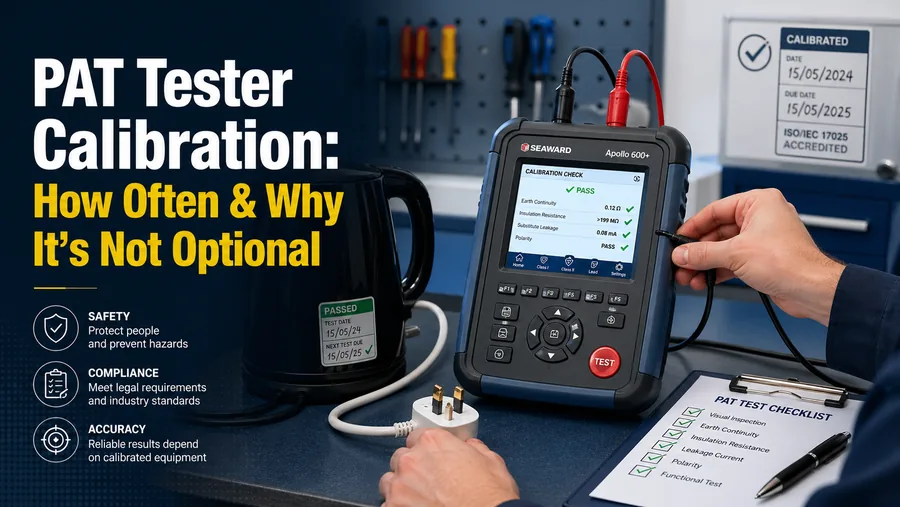
A PAT tester gives you a reading. The question is: is the reading accurate?
Without calibration, you don't know. The instrument measures what it measures, but whether those measurements are within tolerance — whether 0.05 ohms on the screen really is 0.05 ohms, whether 1.2 megohms really is 1.2 megohms — depends on the equipment having been verified against a known standard at appropriate intervals.
This post covers what calibration actually is, why it matters for PAT testing specifically, how often it's needed, what it costs, and what happens if you skip it.
What calibration actually is
Calibration is the process of comparing the readings of your PAT tester to a known reference standard, identifying any drift from accuracy, and either adjusting the tester or documenting the deviation.
It's done by sending the tester to a calibration laboratory (or, for some testers, having an engineer come to you with reference equipment). The laboratory:
- Runs a series of test signals through your tester
- Compares the tester's readings to traceable reference values
- Records the differences
- Either adjusts the tester to bring it back into tolerance, or records the offsets as a calibration certificate
- Issues a calibration certificate showing the readings, dates, traceability and any limitations
The calibration certificate is what you keep. It's the document that proves your tester was performing accurately on the date of calibration.
Why calibration matters for PAT testing
PAT testing relies on specific pass/fail thresholds:
- Earth continuity: less than 0.1Ω + cable resistance for Class 1 appliances
- Insulation resistance: greater than 1.0 MΩ for Class 1, 2.0 MΩ for Class 2
These thresholds aren't arbitrary — they're set by IET standards based on the safety implications of failures. An earth continuity reading just above 0.1Ω is fine; just below isn't.
If your tester is reading high (overestimating) earth continuity, you might pass appliances that actually fail. If it's reading low (underestimating), you might fail appliances that are actually fine. Either is a problem:
- False passes leave dangerous appliances in service
- False fails waste time and money replacing equipment unnecessarily
Calibration ensures the readings match reality.
How often calibration is needed
The standard is every 12 months. This is:
- Recommended by IET guidance
- Required by most accreditation schemes
- Required by virtually all UK insurers for professional PAT testers
- Industry-standard practice
Some specialist environments require more frequent calibration:
- Healthcare and laboratory testing: every 6 months in some contexts
- High-volume professional testers: often calibrated every 6-9 months as a matter of practice (heavy use accelerates drift)
- Critical applications: pre-test verification on each session
For occasional in-house users testing only their own organisation's equipment, 12 months is universally sufficient.
Why 12 months specifically?
The 12-month interval is supported by manufacturer guidance and industry consensus. PAT testers are robust instruments but they're still electronic devices subject to:
- Component aging and drift
- Temperature variation effects
- Mechanical wear of switches, leads and connectors
- Battery condition affecting analog measurements
- Environmental contamination
Most testers stay within tolerance for well over 12 months, but the 12-month interval provides confidence and audit trail. Skipping calibration entirely means accepting drift you can't quantify.
What does calibration cost?
UK 2026 calibration prices for typical PAT testers:
- Standard pass/fail PAT tester: £40-£60 per calibration
- Mid-range downloading PAT tester: £50-£80 per calibration
- Advanced multi-function tester: £60-£100 per calibration
Cost typically includes:
- Bench calibration of all measurement functions
- Functional check of all features
- Battery condition check
- Calibration certificate with traceability
- Return shipping
Some calibrators offer collection-and-delivery for £15-30 extra, useful for businesses without postage handling capability.
For multi-tester operations, framework agreements with calibration laboratories often reduce per-unit costs to £30-40 per tester.
What does the calibration certificate look like?
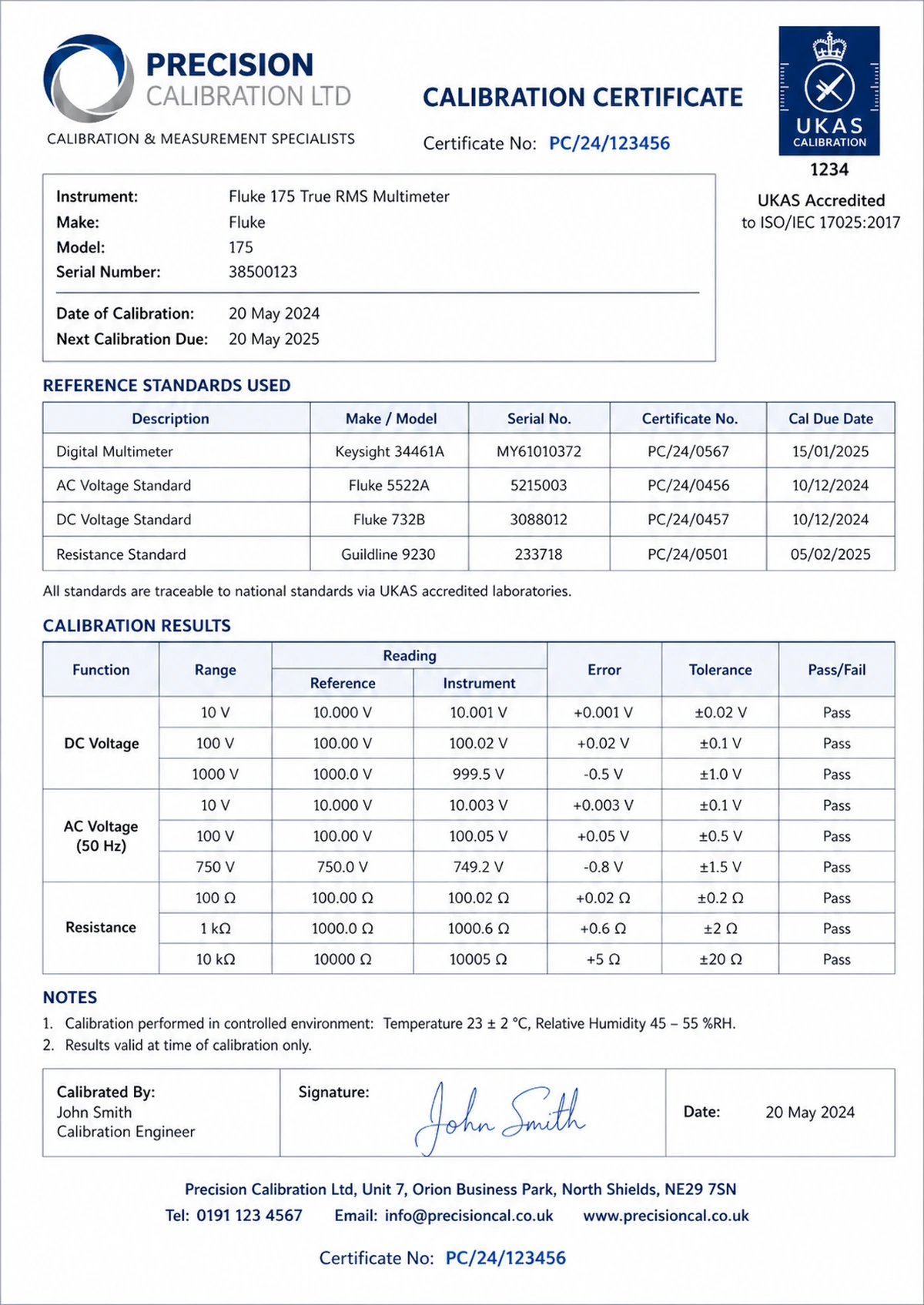
A typical calibration certificate includes:
- The instrument identifier (make, model, serial number)
- Date of calibration
- Date of next calibration due (12 months later)
- The calibration laboratory's accreditation (typically UKAS Accredited)
- Reference standards used and their own calibration traceability
- Specific readings: actual vs reference for each measurement function
- Any tolerances or notes
- Authorised signature of the calibration engineer
- Reference number
The certificate is your evidence. Keep both physical and electronic copies.
Who calibrates UK PAT testers?
Several specialist UK calibration laboratories:
- Manufacturer-affiliated centres: Seaward, Megger, Martindale, Kewtech all have authorised calibration partners
- Independent calibration services: companies dedicated to electrical instrument calibration
- Tool hire and equipment specialists: some hire companies offer calibration alongside their core business
- In-the-field calibration services: less common for PAT testers specifically, but available
Look for:
- UKAS accreditation (United Kingdom Accreditation Service) — the gold standard
- ISO 17025 accreditation — international quality standard for calibration laboratories
- Manufacturer authorisation — ensures the calibration follows manufacturer specifications
Avoid uncertified calibration providers. The whole point of calibration is the accreditation chain — calibration without traceable accreditation is essentially worthless for compliance purposes.
When calibration is needed beyond the annual schedule
In addition to the standard annual cycle, calibration is needed:
After equipment damage
If your tester is dropped, bumped hard, or shows signs of physical damage, calibration confirms it's still within tolerance.
After internal repair
Any repair work — replacing leads, fixing battery contacts, replacing internal components — should be followed by calibration to confirm the repair didn't affect accuracy.
After significant environmental exposure
Testers exposed to extreme conditions (very wet sites, high humidity, dusty environments) may benefit from earlier calibration.
Before an audit or major test
If you're being inspected or your work is being reviewed, ensuring you have current calibration evidence avoids the awkward situation of presenting marginally-out-of-date documentation.
The legal position
Calibration isn't strictly a legal requirement in the way that PAT testing itself isn't. But:
- The Electricity at Work Regulations 1989 require equipment to be properly maintained and accurate
- The IET Code of Practice expects calibration
- Most insurance policies for PAT testers require current calibration
- Most accreditation schemes (NAPIT, Stroma, etc.) require calibration
- Most professional clients require evidence of calibration
In practical terms: working without current calibration is professionally untenable and probably uninsurable. Whether or not it's strictly illegal, it's not a viable position.
Records and tracking
Keep:
- All calibration certificates throughout the life of the tester
- A calibration history log showing dates, results, and any adjustments
- Reminders for next calibration date (12 months from current calibration)
For multiple testers, a tracker spreadsheet showing:
Software-based asset management (PATGuard, SimplyPats etc.) typically handles this automatically.
What happens if you skip calibration?
The realistic consequences:
Insurance implications
Most PAT testing insurance requires current calibration. Working with out-of-calibration equipment can invalidate cover for any claim arising from your testing.
Client refusal
Most professional clients ask for proof of calibration. Showing them a 18-month-old calibration certificate is a problem; not having one at all means they won't engage you.
Audit failure
In any compliance audit, calibration is one of the first things checked. Out-of-date calibration means the testing carried out using that tester is questioned.
Increased risk of false readings
Beyond the documentation issue, an uncalibrated tester might genuinely be giving false readings. If an appliance is actually faulty but your tester reads it as passing, that's a real safety problem.
Reputational damage
In the small UK PAT testing community, working without calibration develops a reputation. It's a corner that respected testers don't cut.
What about self-calibration?
A few testers offer self-test functions or "auto-calibration" features. These typically:
- Compare internal measurements against internal references
- Useful as a daily check that nothing major is wrong
- NOT a substitute for laboratory calibration
A tester that "self-calibrates" still needs annual external calibration with traceable references. The internal self-test catches gross failures but doesn't verify accuracy to traceable standards.
Battery and self-test checks
Beyond formal calibration, daily checks worth doing:
- Battery check: most testers have a battery indicator; check it's adequate before any testing session
- Lead check: visually inspect test leads for damage
- Self-test: where available, run the tester's internal self-test before commencing
- Reference test: some testers come with a reference resistor that can be used to verify earth continuity readings before each session
These don't replace calibration but they catch problems between calibration cycles.
Frequently asked questions
How often does a PAT tester need to be calibrated?
Every 12 months for typical use. Specialist environments (healthcare, high-volume professional use) may require 6-monthly calibration.
Is PAT tester calibration legally required?
Not strictly by name in any specific regulation, but practically required for any professional or audit-relevant testing. Required by virtually all UK insurers and accreditation schemes.
How much does PAT tester calibration cost?
UK 2026 pricing: £40-£100 depending on tester type. Mid-range downloading testers typically £50-80.
Can I use a PAT tester without calibration?
Technically yes, but it's professionally untenable for paid work. Insurance, client requirements and audit considerations all require current calibration.
Where can I get my PAT tester calibrated?
UKAS-accredited calibration laboratories — typically manufacturer-affiliated centres or independent specialists. Look for UKAS accreditation specifically.
What's a calibration certificate?
A document showing your tester was tested against traceable reference standards on a specific date, with the readings recorded and any deviations documented. Provides the audit trail proving your tester was accurate.
Can I calibrate my own PAT tester?
Generally no, beyond rough self-checks. Proper calibration requires reference equipment that's itself calibrated to traceable standards — a chain of calibration that an end-user can't replicate.
What if calibration shows my tester is out of tolerance?
The calibration laboratory either adjusts the tester to bring it back into tolerance, or documents the deviation and recommends specific actions. In either case, you'll know exactly what's happened and what the implications are.
The takeaway
Calibration is the audit trail that proves your PAT tester is giving accurate readings. The cost is modest (£40-100 per year) and the consequences of skipping it are serious — insurance refusal, client disengagement, audit failure, and the underlying risk that you're producing testing results that aren't actually valid.
Schedule annual calibration through a UKAS-accredited laboratory, keep all certificates as part of your testing records, and treat calibration as part of the cost of doing business — alongside insurance and qualifications.
For testers building their professional practice, an accredited PAT testing course covers calibration requirements alongside the practical testing skills, so this becomes part of your foundational competence rather than something you encounter awkwardly later. The combination of qualification, calibrated equipment and proper insurance is what makes professional PAT testing viable — calibration isn't optional within that framework.