
%201.svg)


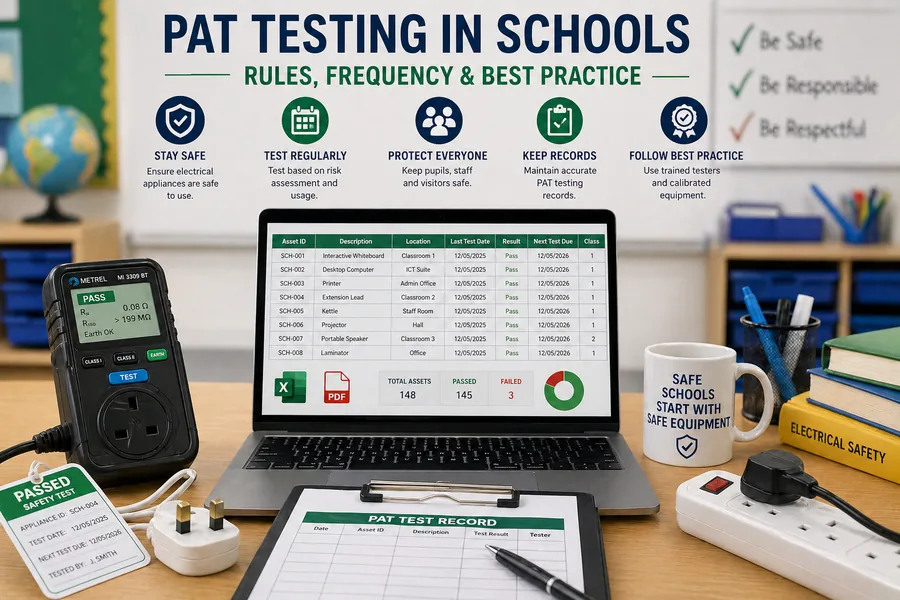
Schools occupy a particular category in PAT testing terms. Children using equipment, supervised but not always closely; classrooms full of plug-in devices; specialist departments (D&T, science, music) with their own equipment risks; and a duty of care that goes beyond standard workplace requirements because the people most exposed are minors.
This post covers what UK schools actually need to do for PAT testing, how the rules differ from standard workplaces, where the practical pressure points are, and how to build a regime that works within school operations.
The duty of care in schools
Schools sit at the intersection of several legal frameworks:
- The Health and Safety at Work Act 1974 — staff are employees, so standard workplace duties apply
- The Electricity at Work Regulations 1989 — applies to all electrical systems in school premises
- The Children Act 1989 and broader safeguarding legislation — additional duties because children are involved
- Sector-specific guidance from the DfE, Ofsted, and local authorities for state schools, or from inspection bodies (ISI, COBIS) for independent schools
The combined effect is that schools are treated as a higher-risk environment for electrical equipment in the IET Code of Practice — with tighter testing intervals than standard offices.
For more on the underlying legal framework, see our post on PAT testing as a legal requirement.
Why schools are different
A few things genuinely make schools different:
Children are not trained users
Office equipment is used by trained adults who understand cable management, can spot obvious damage, and won't deliberately misuse equipment. School equipment is used by children who don't know about earth continuity, can't tell a damaged plug from a normal one, and sometimes deliberately push limits.
High equipment density
Modern classrooms have laptops or tablets on every desk, interactive whiteboards, projectors, audio systems, sometimes printers — a 30-pupil classroom often has 35+ testable items. Multiplied across a typical primary school, that's easily 1,000-2,000 items. A secondary school can easily have 5,000-10,000.
Specialist department risks
Some school departments handle equipment with very different testing needs:
- D&T workshops: power tools, soldering irons, electric saws — high-risk handheld equipment
- Science labs: hot plates, water baths, centrifuges — specialist electrical equipment
- Music technology: amplifiers, mixers, instrument equipment — high cable-flex environment
- Catering technology: full commercial kitchen equipment
- PE departments: trampoline switches, gym equipment with electrical components
Holiday testing windows
Schools have unique scheduling: meaningful PAT testing access typically only happens during school holidays. That creates concentrated workload windows and makes contractor scheduling crucial.
Inspection regimes
Both Ofsted (state schools) and the ISI/independent inspectors review safety procedures. While they don't audit individual PAT testing records, persistent failures or any incident makes this a key area in the resulting inspection.
Recommended testing frequency for schools
The IET Code of Practice gives schools tighter intervals than standard offices:
| Appliance type | Class 1 | Class 2 |
|---|---|---|
| Handheld equipment | 12 months | 48 months |
| Portable equipment | 12 months | 48 months |
| Movable, stationary and fixed | 48 months | 48 months |
| IT equipment | 48 months | 48 months |
Note that handheld and portable Class 1 items are on annual cycles in schools — significantly more frequent than standard office intervals (24 months). This reflects the higher-risk pupil-using-equipment scenario.
Some specialist environments within schools warrant tighter intervals still:
- D&T workshops: similar to industrial sites — 6-month cycles for handheld tools
- Pottery kilns and specialist science equipment: per manufacturer guidance plus PAT
- PE equipment with electrical components: 12-month cycles minimum
For full frequency guidance, see our PAT testing frequency post.
What to test in schools
Building the asset register is the first major job. School PAT testing inventories typically include:
Classroom equipment
- Interactive whiteboards (Class 1 or 2 depending on construction)
- Projectors and ceiling-mounted projectors (with associated leads)
- Document cameras
- Speakers and audio systems
- Laptops/tablets and their chargers (chargers tested, not the devices)
- Desktop PCs in computer rooms
- Printers and photocopiers
- Plug-in lighting (table lamps, accent lighting)
Office and admin
- All standard office equipment as per PAT testing for IT equipment
- Reception equipment
- Photocopiers in admin areas
- AV equipment in halls and meeting rooms
Kitchen and catering
- Full commercial kitchen equipment in school kitchens
- Smaller kitchens in staff rooms (kettles, microwaves, fridges)
- Vending machines
Specialist departments
- Science: Bunsen burner igniters, hot plates, centrifuges, water baths, electronic balances
- D&T: power tools (drills, saws, sanders), soldering irons, glue guns, kilns
- Art: kilns (high-risk), heat presses
- Music: amplifiers, mixers, electronic instruments, recording equipment
- PE: trampoline interlocks, treadmills, gym equipment, defibrillators
- Drama: stage lighting, sound systems, smoke machines
Maintenance and groundskeeping
- Cleaning equipment (vacuums, polishers)
- Power tools used by site staff
- Maintenance department equipment
Outdoor and site equipment
- Outdoor lighting (where plug-in)
- Minibus charging points (specialist)
- Sports field PA systems
Areas commonly missed
- Equipment in storage cupboards (still needs testing if returning to service)
- Equipment in school sheds and outbuildings
- Off-site equipment (school trips, residential trips)
- Equipment used at parent-teacher events (lighting, music systems)
Practical scheduling for schools
The unique challenge for schools is that meaningful access to most equipment requires children not to be there. The standard approach:
Major testing rounds during school holidays
- Summer holidays: largest testing round, often the full school
- Easter holidays: focused testing on specialist departments
- Half-terms: spot testing of specific high-priority areas
In-term testing of accessible items
- Office and admin equipment can be tested during normal school hours
- Kitchen equipment can be tested during evening or weekend access
- Maintenance store items can be tested anytime
Contractor scheduling
Most external PAT testing contractors recognise the school holiday pressure and have specialist school programmes. Booking early in the academic year is essential — popular contractors fill summer holiday slots months in advance.
In-house testing model
Many larger schools (particularly secondaries and independents) have moved to in-house testing with a trained site manager or maintenance staff member as the competent person. The advantages:
- Testing can happen across the year, not just in concentrated holiday windows
- Failed equipment doesn't sit on the school floor for weeks waiting for contractor return
- Cost savings are significant at school-scale appliance counts
A one-day accredited PAT testing course gives a member of site staff the qualification to handle school testing properly. For schools with 1,000+ items, the saving compared to contractor pricing typically recovers the training cost in the first year.
High-risk areas that often get missed
A few specific issues come up repeatedly in school PAT testing:
Pupil-modified equipment
Children are remarkably creative with classroom equipment. Pencils stuck in sockets, modified plugs, cables wrapped in unusual ways. Visual inspection in classroom environments needs particular attention.
Music technology cables
Studio environments have huge numbers of high-flex cables that get manipulated constantly. Cable failure rates are noticeably higher than other school environments.
D&T workshop tools
The combination of pupil use, frequent movement, and hostile environment (sawdust, knocks, drops) makes D&T tools the highest-fail-rate category in many schools.
Old kit in storage
Schools keep equipment indefinitely. Old projectors, decommissioned PCs, retired audio systems — they sit in storage and occasionally come back into service. Anything returning from storage needs full PAT testing before being put back into use.
Donated equipment
Schools receive significant donations from parents, businesses, and community groups. Donated equipment should be treated as second-hand and fully PAT tested before being used, not assumed safe because it was a gift.
School trip and residential equipment
Equipment taken on trips (audio gear, projectors, electrical kit for outdoor learning) gets exposed to environments far harsher than the classroom. After-trip testing is sensible.
Documentation for schools
School PAT testing records typically need to integrate with:
- The school's broader compliance documentation
- Ofsted/inspection-ready evidence
- Insurance documentation
- Local authority compliance reporting (state schools)
Most schools maintain PAT testing records as part of a wider site compliance management system. For the asset register and test logging structure itself, see our record sheet template post.
Particular things to track that are school-specific:
- Department/year group ownership of equipment
- Equipment that's portable across departments (shared AV kit, projectors)
- Equipment used outside school premises (trips, residentials)
- Equipment specifically for SEN/EHCP students (specialist communication equipment, hearing loops)
Working with the school's wider compliance regime
PAT testing is one of several electrical safety strands schools manage:
- 5-yearly EICR of the fixed electrical installation
- Annual PAT testing of relevant appliance categories
- Daily/weekly visual checks by users (teachers and pupils for their equipment)
- Termly formal visual inspections by site staff
- Specialist equipment maintenance (kilns, lab equipment) per manufacturer
- Fire alarm systems under separate fire safety regulations
- PAT testing of fire equipment where applicable (e.g. fire alarm panels, emergency lighting)
The PAT testing regime should integrate with the school's overall compliance calendar, not stand alone. Many schools use a single compliance management system to track all electrical safety alongside fire, water, asbestos and other regulated areas.
Cost of school PAT testing
Outsourced testing for a typical UK secondary school:
- 2,000-5,000 testable items
- Annual cost from contractor: £2,000-£8,000 depending on contractor and complexity
In-house testing for the same school:
- One-day course + tester: £600-1,000 upfront
- Subsequent annual cost: site staff time only (~10-20 days/year for a full school round)
- Net annual saving: £1,000-7,000 depending on previous contractor cost
For small primary schools (<500 items), the contractor route often remains the most practical. For secondaries and large primaries, in-house typically pays back rapidly.
Frequently asked questions
Are schools legally required to PAT test?
Not by name, but the Electricity at Work Regulations 1989 and the Health and Safety at Work Act 1974 effectively require it. Schools are categorised as higher-risk environments because of pupil involvement, leading to tighter standard testing intervals.
How often should school equipment be PAT tested?
Class 1 handheld and portable equipment in schools is on a 12-month cycle (more frequent than standard offices at 24 months). Class 2 equipment and IT/stationary equipment is on 48-month cycles. Specialist environments (D&T workshops) need tighter intervals.
Who should do PAT testing in schools?
A competent person — either an external contractor with school experience, or an in-house site manager trained through an accredited PAT testing course. Many larger schools find in-house testing more cost-effective once they reach 1,000+ appliances.
Do school laptops and tablets need PAT testing?
The devices themselves don't (battery-powered with low-voltage DC), but their chargers do as Class 2 appliances, plus the IEC leads between chargers and walls.
Do school kitchens need separate PAT testing?
Commercial kitchens have specialist equipment with specialist testing needs. Standard PAT testing covers what's plug-connected; some specialist equipment may need manufacturer-specific inspection alongside.
What about school equipment used off-site?
Equipment used on school trips, residentials, or in off-site events remains under the school's duty of care and falls within the PAT testing regime. Many schools test such equipment more frequently because of the harsher environments.
Can a teacher do PAT testing for their own classroom?
A teacher who has completed an accredited PAT testing course is a competent person and can test equipment. In practice, most schools centralise testing through site staff rather than distributing it across teaching staff.
The takeaway
School PAT testing is more demanding than standard workplace testing because of higher equipment density, pupil involvement, specialist department risks, and the practical challenge of holiday-window scheduling. The IET intervals reflect this: handheld and portable Class 1 items are on annual cycles, tighter than standard offices.
For most secondary schools and larger primaries, training a member of site staff through a proper PAT testing course typically pays back in the first year compared to contractor pricing — and gives the school control over scheduling rather than fitting around contractor availability.
Build a complete asset register, schedule major testing rounds during school holidays, train an in-house competent person where the volume justifies it, and integrate PAT testing into the wider compliance calendar. That's the workable school PAT testing regime in full.