
%201.svg)


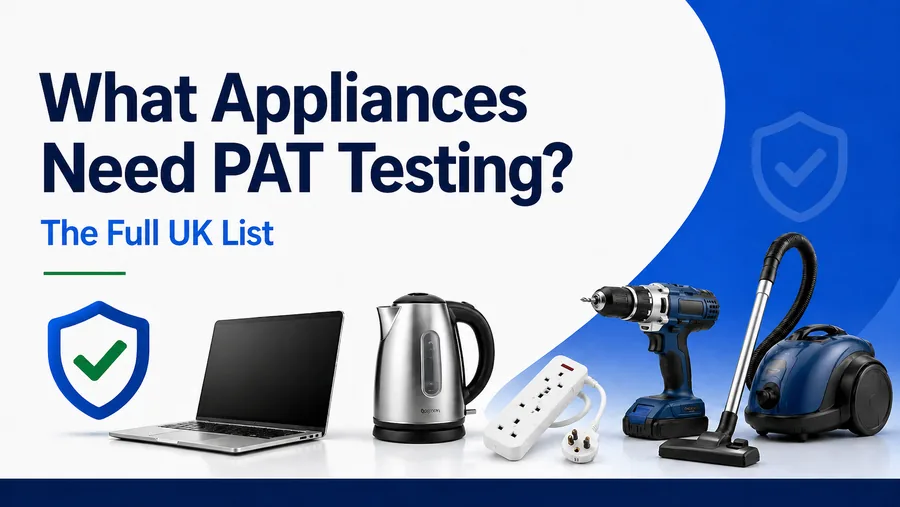
The simple answer: any mains-powered electrical appliance used in a workplace, rental property or public premises is potentially in scope for PAT testing. The slightly more complicated answer is that the type of test, the frequency of testing and even whether testing applies at all depends on what the appliance is, how it's classed and how it's used.
This guide gives you the full picture — what needs testing, what doesn't, and the rule behind each category. By the end, you'll be able to walk around your premises and confidently identify what's in scope and what isn't.
The basic rule
PAT testing applies to electrical appliances that:
- Are powered by mains electricity (240V or 110V), and
- Are connected to the supply via a plug, lead or socket — not hardwired into the building's fixed installation, and
- Are used in a workplace, rental property, public-facing premises or anywhere else where a duty of care applies
That covers everything from a kettle in an office kitchen to a printer, a phone charger, a vacuum cleaner, a fridge, a microwave or a desk fan. If it has a plug and it's not your own personal home appliance, it almost certainly needs testing at some interval.
What's in scope: the full list
Below is a categorised list of appliance types that fall under PAT testing requirements. Within each category, individual frequency depends on the environment and class — see our PAT testing frequency guide for the specific intervals.
Kitchen and break-room appliances
- Kettles
- Toasters
- Microwaves
- Fridges and freezers (small/under-counter and full-size)
- Dishwashers (where plug-in)
- Coffee machines
- Water dispensers
- Sandwich toasters and panini grills
- Slow cookers and rice cookers
- Vending machines
These are typically Class 1 appliances (the metal casing relies on an earth connection for protection). Kitchen environments mean cables get heat-stressed and casings get knocked, so testing frequency is at the higher end for the environment.
IT and office equipment
- Desktop PCs and monitors
- Laptops and laptop chargers (the charger is what gets tested, not the laptop)
- Printers and photocopiers
- Scanners
- Phone chargers and tablet chargers
- Desk fans and small heaters
- Desk lamps
- Shredders
- Projectors
- Server room equipment
We have a dedicated guide for this category — see PAT testing for IT and computer equipment. IT equipment generally sits in a lower-risk category with longer testing intervals.
Cleaning equipment
- Vacuum cleaners
- Floor polishers and scrubbers
- Carpet cleaners
- Pressure washers
- Steam cleaners
Cleaning equipment is dragged around constantly, has the cable yanked, and gets exposed to moisture. It's typically the highest-failure-rate category in any given workplace.
Power tools and workshop equipment
- Drills, sanders, grinders (corded)
- Saws (circular, jigsaw, mitre)
- Soldering irons
- Workshop lighting and inspection lamps
- Bench grinders
- Battery chargers for cordless tools
- 110V site equipment
Power tools used on construction sites have particularly tight testing intervals (3 months for handheld tools). Our PAT testing frequency table has the specifics for site work.
Heating and ventilation appliances
- Plug-in fan heaters and convector heaters
- Oil-filled radiators
- Air conditioners (portable units)
- Dehumidifiers
- Fan coolers
- Fixed wall-mounted heaters (where they have a plug — see "fixed appliances" below)
Higher-wattage appliances put more stress on plugs and sockets. Heaters in particular are worth checking visually before each season they're brought back into use.
Extension leads, multi-way adapters and IEC leads
- All extension leads (single, multi-socket, reel-type)
- 4-way and 6-way adapters
- IEC kettle leads (the detachable lead from PCs, monitors, kettles)
- Travel adapters in commercial use
Extension leads are one of the highest-risk categories — heavily used, regularly damaged, and frequently overloaded. They have their own specific test sequence and warrant their own deep-dive in our extension lead PAT testing post.
Fixed appliances
- Wall-mounted hand dryers
- Hard-wired wall heaters
- Fixed extractor fans
- Built-in commercial cooking equipment
- Fixed water heaters
"Fixed" doesn't mean exempt. It means the appliance is bolted to a structure or hard-wired into the supply rather than plugged in. Fixed appliances are still tested, but the procedure is slightly different (and the testing intervals are usually longer). Our fixed vs portable appliances guide covers the distinction in detail.
3-phase equipment
- Industrial machinery
- Commercial cooking equipment using 3-phase supply
- Some larger HVAC plant
- Industrial laundry equipment
3-phase appliances need a tester capable of handling them, and often need a competent tester who's specifically experienced with industrial equipment. Many standard PAT testers don't handle 3-phase.
Hire and event equipment
- Stage and event lighting
- PA systems and audio equipment
- Marquee heaters and fans
- Hired power tools and machinery
- Catering equipment for events
Equipment hired out to customers should be inspected and tested before every hire — not just at the standard interval. This applies whether you're a hire company or a venue providing hired-in kit.
What's NOT in scope for PAT testing
A few categories of equipment fall outside PAT testing entirely:
Hardwired fixed installations
The building's fixed wiring — sockets, light fittings, the consumer unit, ring main wiring — is not tested by PAT testing. That falls under the EICR (Electrical Installation Condition Report) regime instead. We compare them in our PAT testing vs EICR post.
Battery-only equipment
Equipment that's permanently battery-powered and never connected to the mains — like a cordless screwdriver running off a battery pack — isn't PAT tested. The charger for that battery is tested, but the tool itself isn't.
Equipment with no detachable mains lead used at low voltage
Some specialist equipment (signal boosters, PoE-powered devices) doesn't need PAT testing because it isn't directly mains-connected.
Brand-new equipment (initial check only)
New equipment doesn't need a full combined PAT test before first use — only a formal visual inspection. It then enters the standard testing regime at the appropriate interval. See our post on PAT testing new appliances for the full detail.
Personal home appliances used at home
If you own and use the appliance personally in your own home, it's not in scope. The exceptions are home-based businesses, home offices used by employees, and any rental arrangement — see our domestic PAT testing guide.
How to know whether an appliance is Class 1 or Class 2
Whether something gets a full electrical test (Class 1) or a slightly reduced sequence (Class 2) depends on its construction. The quick check:
- Class 1 appliances have a metal external casing or exposed metal parts that could become live in a fault. They need an earth connection — visible as the third pin on a UK plug or via a separately wired earth.
- Class 2 appliances have double or reinforced insulation throughout — there's no need for an earth because the insulation alone protects the user. They're marked with a square-within-a-square symbol.
Our Class 1 vs Class 2 guide has photos, examples and the symbol explained in detail.
What about employees' own equipment brought to work?
This trips up many businesses. If an employee brings their own kettle, fan, charger or radio into the workplace and uses it there, it falls under your duty of care. You're responsible for ensuring it's safe — which in practice means it needs to be PAT tested alongside your own equipment.
The pragmatic approach is a clear policy: any personal item brought to work for use must be added to the PAT testing register, or it must be removed. Most employees don't realise this and are happy to comply once it's explained.
What does each appliance get tested for?
Different appliance types get different test sequences. The summary:
- Class 1 portable appliances: visual inspection, earth continuity test, insulation resistance test, polarity check, functional check
- Class 2 portable appliances: visual inspection, insulation resistance test (or substitute leakage), functional check (no earth test)
- Extension leads: visual inspection, polarity check on each socket, earth continuity (where applicable), insulation resistance
- IEC leads: continuity test on each conductor, polarity, insulation resistance
- Fixed appliances: visual inspection, earth continuity (where applicable), insulation resistance — usually with the appliance disconnected and tested via leads
The full procedure is covered in our PAT testing checklist post.
Frequently asked questions
Does a kettle need PAT testing?
In a workplace, rental property or public premises — yes. Kettles are typically Class 1 appliances and one of the most commonly tested items. In a private home for personal use, no.
Do laptops need PAT testing?
The laptop itself doesn't (it runs on internal battery and low-voltage DC). The laptop charger does — it's a mains-powered Class 2 appliance and gets a standard Class 2 test. The IEC lead between the wall and the charger also gets tested.
Do fridges need PAT testing?
Yes, in commercial and rental settings. Fridges are typically Class 1 and tested at the same interval as other portable kitchen equipment, though their movable status (rather than handheld) gives slightly longer intervals.
Do extension leads need PAT testing?
Yes — and arguably more than most other items, because they're moved, knocked and overloaded constantly. They have their own test sequence and tighter inspection intervals than most stationary kit. See our extension lead PAT testing post for the detail.
Do new appliances need PAT testing before use?
Only a formal visual inspection — not a full electrical test. Manufacturers test before despatch, so a new appliance is treated as compliant until it enters its standard testing cycle. Our new appliance PAT testing post covers exceptions.
Do battery-powered tools need PAT testing?
The tool itself doesn't (no mains connection in normal use). The charger does — it's a standard Class 2 appliance and tested as such.
In-house testing makes the inventory easier
For businesses with a wide mix of appliance types, the standard problem with outsourcing is that the contractor tests what's accessible on the day and may miss items in storage, in cupboards or temporarily moved. An in-house tester knows the building, knows what's there, and can build an accurate, complete asset register over time.
If your premises has more than about 50 appliances spread across several categories, training somebody in-house through an accredited PAT testing course usually pays for itself within a year. A one-day course gives them the knowledge to identify which items need testing, what tests apply, and how to document results properly.
The takeaway
If it's mains-powered, plug-connected, used in a workplace or rental, it's in scope for PAT testing. The question isn't whether but how often and what tests. Build a complete asset register, classify each item, set the right interval based on environment and class, and the rest is just running the tests.